[4 April 2017: This post is under heavy construction. -P]
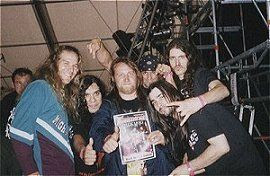
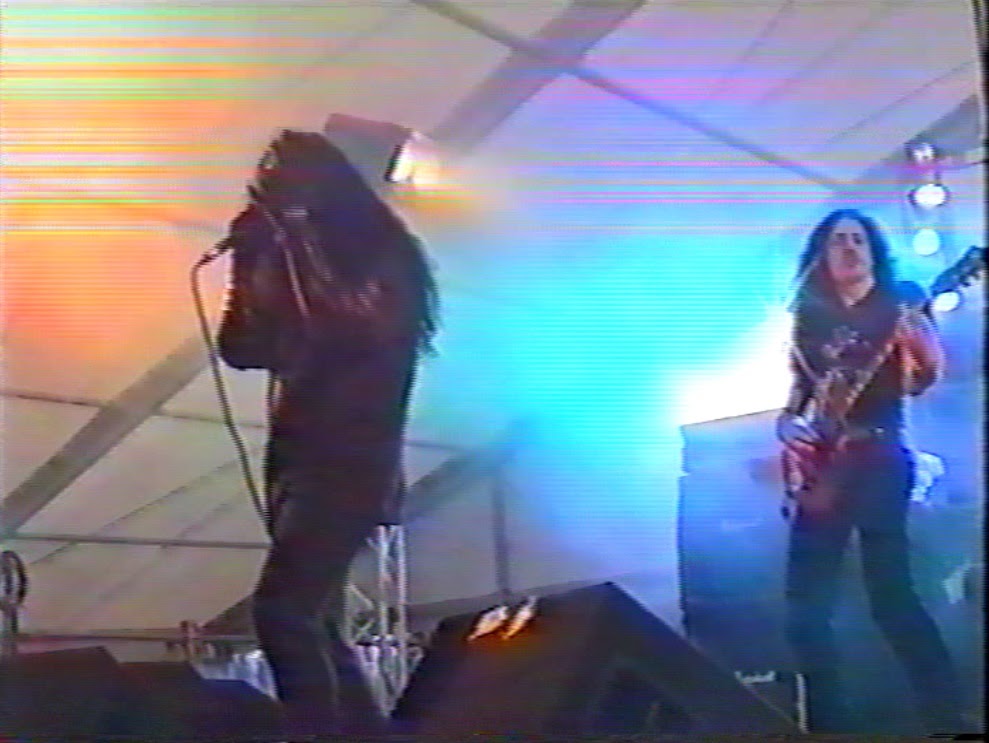
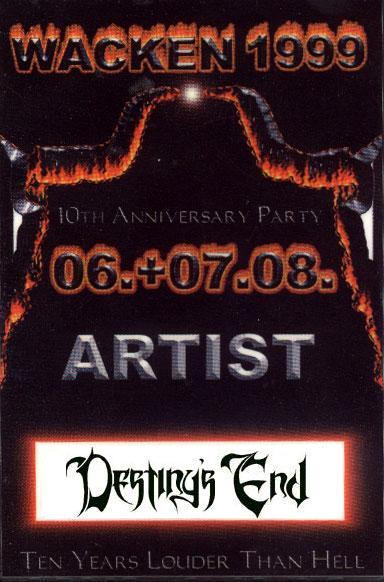
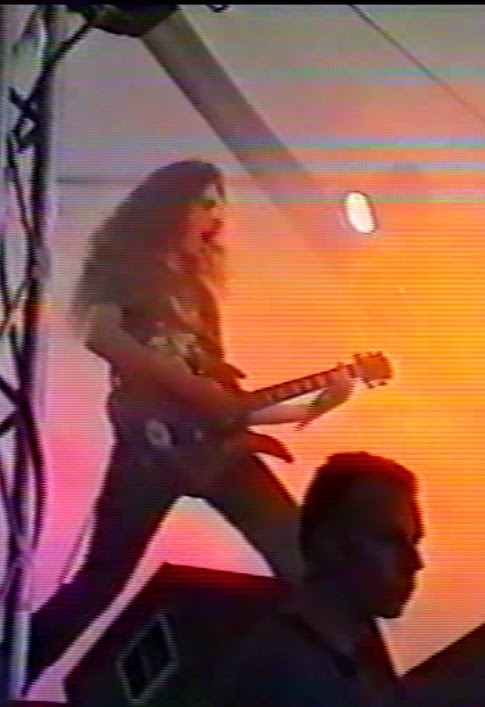
I recently acquired the footage of Destiny's End at Wacken 1999 and uploaded it to YouTube for all to view. So, where do I start to blog the tale of the biggest gig of my career as a muso? From the beginning, I suppose...
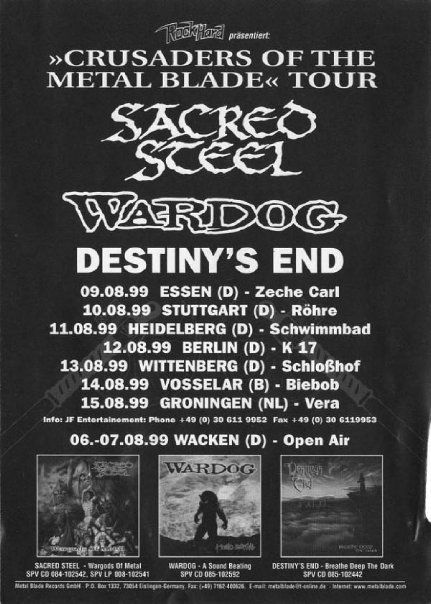
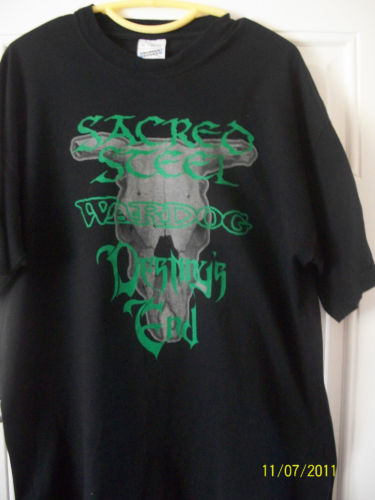
Metal Blade Germany got Destiny's End a slot on the prestigious Wacken Open Air Festival. The good news arrived shortly before we trekked out on a full-scale tour of the US with Iced Earth and Nevermore in May and early June 1999. A mini-European tour with labelmates Sacred Steel and Wardog was also arranged. We had no idea what to expect in terms of logistics. Would we be travelling in a van like in the US? Would we get shared motel rooms some nights? What about the back-line gear? What sort of guitar speaker cabs, bass rig and drums did Sacred Steel have to loan us?
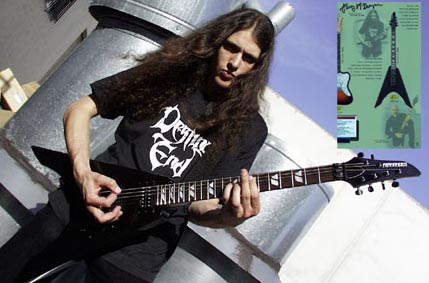
There were challenges to overcome in order to reach European shores. It was my first trip outside the US, and I was a bit stressed about the long flight. It started with some technical issues with one of my main guitars, a white early '80s B.C. Rich Warlock. I spent the night before our departure at Dan DeLucie's pad. We decided to do some last minute string changing. What should have been a routine job turned sour, and it was crystal clear that I wouldn't be able to bring the Warlock. I was kind of apprehensive about taking one of my more valuable axes, but resorted to my trusty 1976 B.C. Rich Eagle instead. As a backup I had a new Fernandes Vortex, a futuristic V-shape, which I wasn't worried much about. The Fernandes could be easily replaced.
Perry with Fernandes Vortex
As it was impossible for Dan DeLucie and I to bring our bulky amp/effects racks, we resorted to using our Mesa Boogie long-chassis heads. At least we knew we'd have adequate tone with our own amps. I borrowed Boss delay and chorus pedals from my pal Aric Villareal to complete the package. Our gear prayers were answered in an email exchange with the Sacred Steel lads. They had boutique German Engl speaker cabs to share with me and Dan, not to mention a full rig for bassist Nardo Andi and SS skinsman Mathias Straub loaned his Tama double-bass kit to DE's Brian Craig. All Brian brought were his cymbals, while Nardo simply needed one of his two Ibanez basses. Sorted! Well, almost...
We miraculously made it to LAX on time and ready for our long-ass flight. Metal Blade Germany arranged our tickets, and for some bizarre reason it was cheaper to fly to Amsterdam first and catch a connecting service to Hamburg. Budget-wise it was a good decision. On the other hand, it could - and did - cause major problems.
After deplaning and making our way through customs, we hightailed it to the baggage claim area to find our gear. Andreas Reissnauer, one of the Metal Blade Germany guys, was there to greet us. The baggage carousels spun around as the minutes ticked away, with no sign of our gear. The oversized luggage section similarly yielded nothing. Though most of our clothes were intact, it became clear that our gear was lost. Andreas spoke to the Lufthansa luggage people. Did he get the message across? Who could tell? What to do, what to do? Whose fault was it? Was Metal Blade the culprit for flying us out the same day as such a critical festival gig, a scant few hours before stage time, knowing fully well that our gear might not make the same flight as us? Did it really matter who was to blame? Hell no! We needed to devise a solution. And quick!
DE at Wacken with Jason from Friday the 13th 'zine
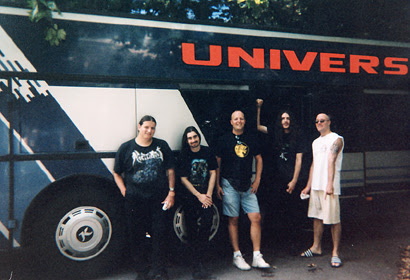
Awake for something like 24 hours, we weren't very prepared to hatch a desperate backup plan. I slipped in and out of a troubled sleep, sitting up in the van on the way out to the fest. Upon arrival at Wacken, we were greeted by Michael Trengert, the head honcho of Metal Blade Germany. He told us we'd better get cracking on finding some gear to use. Tell us something we didn't already know!? I was understandably pissed off at Michael for not flying us out a day before our scheduled appearance. I was pretty annoyed, but got past it swiftly. Michael walked us through the throngs of camping metalheads to meet our new partners in crime, Sacred Steel. We were totally blown away by the double-decker tour bus. But beyond that, would Sacred Steel be willing to help us out? Fortunately the answer was affirmative. Lucky for me, I scored rhythm guitarist Oli Grosshans' trans red B.C. Rich Mockingbird, while Dan ended up with Jorg Knittel's black Charvel bolt-on. Nardo got Jens Sonnenberg's Ibanez four-string, comparable to his own. Another hiccup was introduced, though. Oli and Juerg explained that Sacred Steel tuned their axes down a whole-step to D, while we tuned to standard (E), in Destiny's End. I broke the news to the DE guys. We couldn't tune up to E, as the axes weren't set up for that sort of string tension. We were forced to stay in D for the Wacken set. Another wrench in the works, eh? James would have to transpose his vocals down on the spot to match our whole-step detuning. I often wondered what DE would sound like tuned to D. My fave ultra-heavy band, Death, played in D, and I tuned to E flat in the short-lived Stormhaven in 1996.
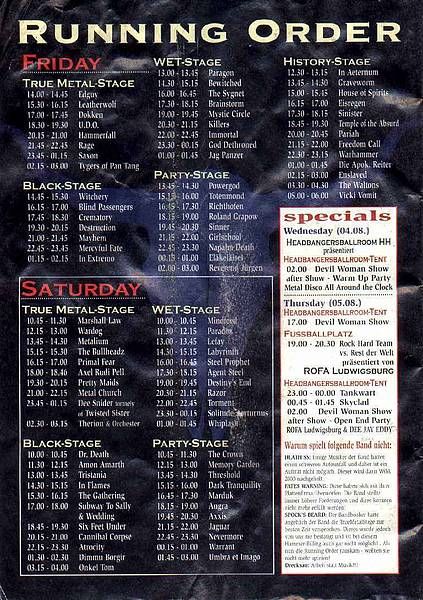
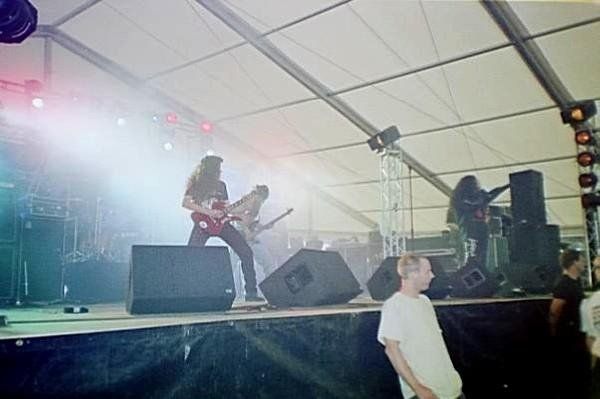
How about the amp situation? Well, it was explained to us that the festival itself had a backline on all of its stages. We made our way through the muddy festival ground, borrowed guitar cases in hand. There was so much metal happening simultaneously, on something like 6 stages. The sheer number of people who flocked to Germany's equivalent of a metal Woodstock was mind-boggling. Looking at the Wacken program, we discovered that we were to play on the Wet stage, one of two smaller stages. Smaller? This was Wacken, and our stage was still pretty massive, easily beating our biggest US gig at the Bluebird Theater in Denver, Colorado. Our adrenaline was beginning to surge. I noted that NWOBHM titans Jaguar, our old touring comrades Nevermore and Metallium (featuring Savatage guitarist Chris Caffrey) were heating up the Party Stage directly across from us.
Slated to play on the Wet Stage before us were our So Cal pals Steel Prophet, followed by Agent Steel. It was comforting to see familiar faces. We hung out backstage with Agent Steel and explained our gear situation. Immediately, a lifesaver was provided by AS axemen Juan Garcia and Bernie Versailles, in the form of a chromatic guitar tuner. Phew! We were very appreciative to Sacred Steel and Agent Steel for saving our asses at Wacken. We stared on as Steel Prophet's Steve Kachinsky jumped around the stage like a madman. Texas doomsters Solitude Aeturnus and Canadian thrashers Razor followed in DE's wake.
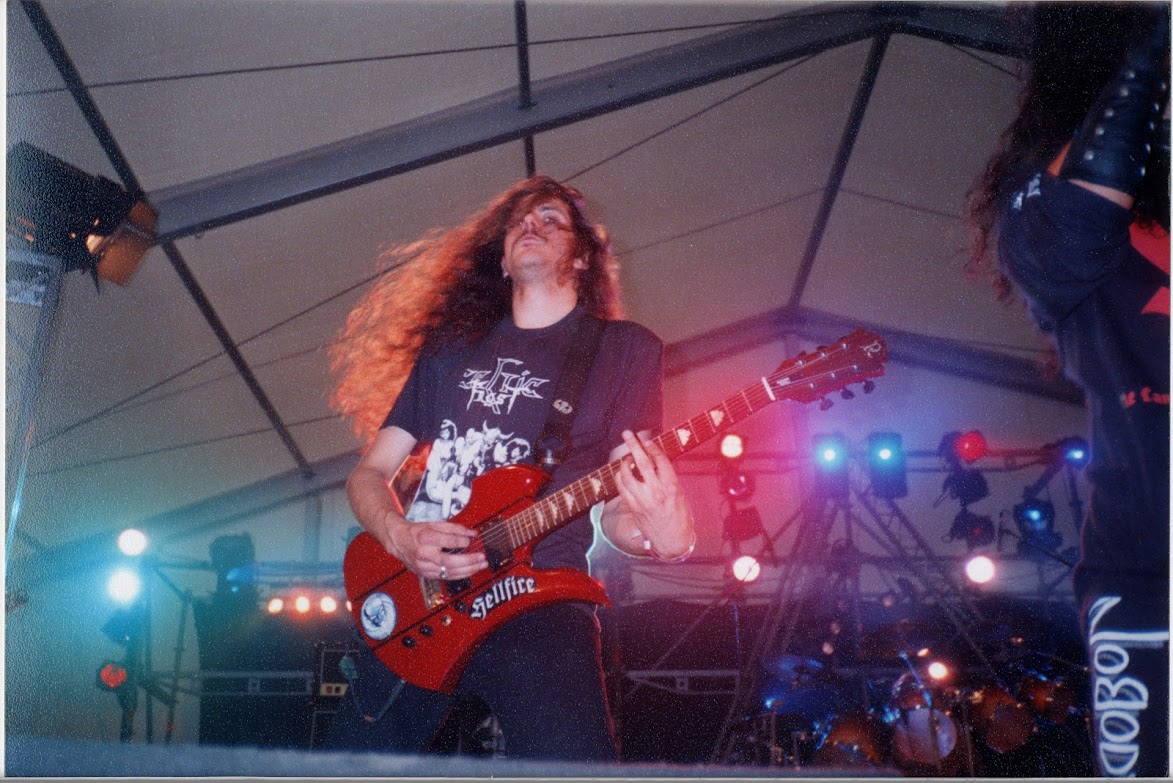
We were on metal overload, and I was a bit more nervous than usual, fearing I might forget how to play a riff or solo. My anxiety was quickly quelled, though. We exchanged pleasantries with Steel Prophet after they departed the Wet Stage and we climbed aboard to find out what our backline consisted of. A couple of Marshall Major JCM 900 200 watt heads and full stacks for me and Dan. An Ampeg SVT head and 8x10" refrigerator cab for Nardo. Brian got to use a Tama double-bass set much nicer than his own Pearl Export Series kit. James lucked out that he had his stage gloves in his carry-on baggage. But James' stage clothes, like our gear, didn't make the flight to Hamburg. As a result he was forced to hit the stage in a Warlord longsleeve and a pair of black sweat pants. The rest of the DE guys wore street clothes live, so it didn't really matter. I chose my Celtic Frost Emperor's Return bootleg t-shirt. Setup time was minimal thanks to the festival's backline.
Dan and I tweaked settings on the Marshalls to approximate our usual high-gain Mesa Boogie tone. We didn't have overdrive or distortion pedals, so it was a relief that the amps themselves pumped out plentiful gain. The sound engineer must've read my mind, as he threw on Death's Individual Thought Patterns on the enormous PA system. I further tested my hired amp by jamming along to "In Human Form". After all, I was tuned to D!
Crusaders of the Metal Blade Tour shirt
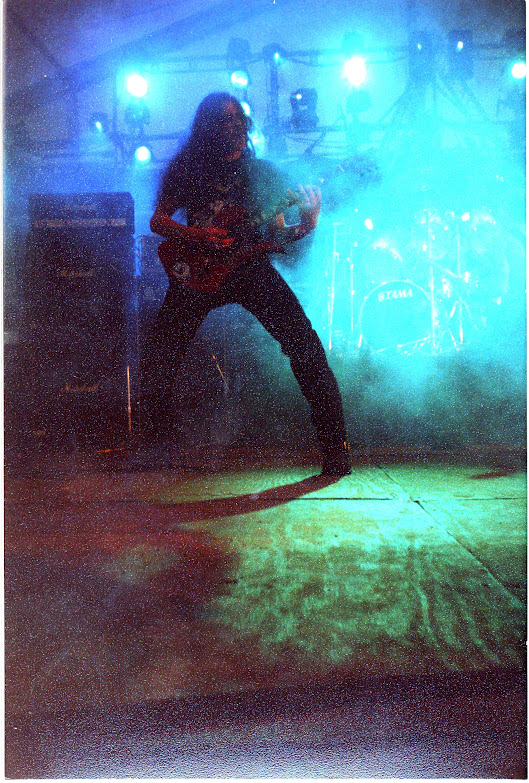
Before we knew it the set was off to a heavy start with mid-paced cruncher "Unsolved World" as the opener.I felt totally at home on Oli Grosshans' Mockingbird. The Wacken audience got a real treat in Dan's new song "Transition", which became the title track to DE's second album. A major difference between this early live version and the recording was Dan's clean-tone guitar intro accompanied by my lead melody. The intro was ditched by the time we demoed the tune months later. Other tunes in the Wacken set were "Breathe Deep the Dark", "Rebirth", "Under Destruction's Thumb", "To Be Immortal", "Idle City/The Fortress Unvanquishable", a cover of Judas Priest's "Beyond the Realms of Death" and Helstar's "The King Is Dead". The feeling of playing in front of a sea of thousands of metal maniacs was unbelievable. A genuine natural high! The crowd went nuts in between songs, chanting at the top of their lungs, "Hey, hey, hey!"
Following DE's set I spotted Solitude Aeturnus bassist Lyle Steadham and caught up with him. We'd last met at DE's March '99 gig in Dallas/Fort Worth at Dimebag Darrell and Vinnie Paul's Tattoo Bar. My old friend Rob Preston also made the pilgrimage to Wacken, and we watched several bands together, including the German thrash band Warrant. No relation to the glam act of the same name!? An interesting aside: Swedish black metallers Marduk were meant to play the Wet Stage several bands after DE, but they failed to appear. In their place was an S&M striptease act, followed by our cohorts Sacred Steel.
Waking up in the bus the morning after Wacken, we discovered our gear had arrived from the airport. What a relief! My UK pen-pal, Solstice's Rich Walker and his wife Lucy were along for the ride with DE and Sacred Steel. The seeds sown at Wacken and the subsequent mini-Euro tour would eventually lead to me playing with Rich on the Isen Torr EP, Mighty and Superior.
Jens Sonnenberg, Dan DeLucie, Jim Powell, Perry and Gerrit Mutz
What about the tour? Suffice it to say that it was a well organized and professional affair. We shared a massive bus with Sacred Steel and got enough sleep in our bunks to be at the top of our game every gig. That's not all we shared with Sacred Steel. We had a tour manager, a merch girl, three roadies, including guitar and drum techs. Dan, Nardo and I didn't even have to change our own strings, which was a breath of fresh air. There was even a wee bit of pyrotechnics in the form of small flash-pots. Although part of the package tour, Wardog travelled on their own in a van with their wives and got motel rooms. Slough Feg was the opener on a couple of dates.
[22 November 2016: This post is under heavy construction. I'll be adding more text, links, photos and correcting errors as time moves along. -P]
For a limited time I'm offering the eponymous first Falcon disc for free download. I'm down to my last few remaining copies of the second small pressing. Rather than letting it languish out of print and fade into obscurity, I'm making it available to fans old and new.
Simply right-click on the link and "save link as". Then decompress once you've downloaded the .zip file.
Perry Grayson - Guitar/Vocals
Greg Lindstrom - Bass/Keyboard/Additional Lead Guitar on *
Darin McCloskey - Drums
Basic tracks recorded live in November 2003. A few overdubs and mixing conducted in February 2004. Engineered, mixed and mastered by Chris Kozlowski at the Polar Bear Lair in Middletown, Maryland. Produced by Falcon and Chris Kozlowski. Released May 24, 2004 on Liquid Flames Records, piece code LF002.
1. Downer (Grayson)
2. Castle Peak (Grayson)
3. On the Slab [guest lead vocals by Bobby Liebling from Pentagram] (Grayson)
4. The Crying of Lot 246 (Grayson)
5. Throwback (Grayson)
6. Redman [Bang cover] (D'Iorio, Ferrara & Gilcken)
7. High Speed Love (Lindstrom) *
8. Route 666 (Lindstrom)
9. Shelob's Lair (Lindstrom) *
10. Half Past Human (Lindstrom) *
The Eponymous Epic!
The self-titled Falcon album has to be my fave recording experience of my career. Not only do I love it sonically, but I really dug/dig everything about the project from start to finish. I don't use the term "project" to describe Falcon, though. It's a serious band situation.
Me and Greg L. flew out to Pennsylvania on November 19, 2003, for two days of wall-to-wall jamming at Pale Divine's rehearsal space (the Glen Mills, PA community center basement). Then we drove down to Maryland and hit the Polar Bear Lair studio for 5 more days. We banged out the basic tracks within two full days, followed by 3 more days of overdubs and mixing - a couple of guitar solos, vocals, percussion, etc. The result was a spontaneous, raw sounding album. We truly bashed it out as quick as humanly possible! A breath of fresh air compared to the recording sessions of Destiny's End - Breathe Deep the Dark.
Chris Kozlowski did an incredible job engineering and Darin did a killer job behind the kit, despite the fact that we haven't had more than like 6 rehearsals with him! An especially huge thanks goes out to Greg Diener (guitarist/vocalist of Pale Divine) for loaning me his old Sunn Sceptre head for rehearsals. We returned to the Polar Bear Lair from February 18th to 21st to do a couple of last overdubs and to mix.
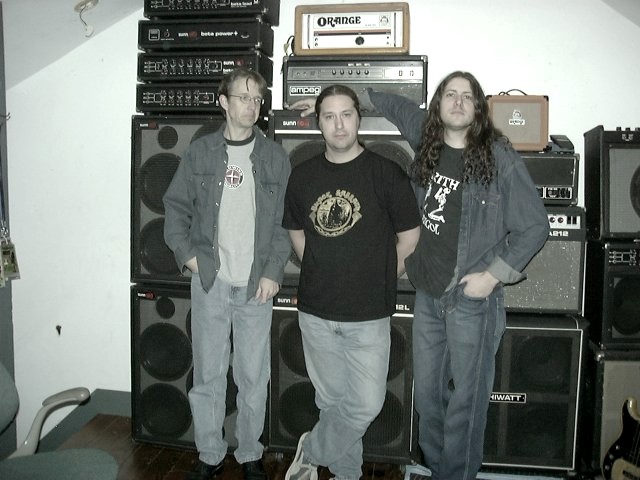
Greg, Darin & Perry inside Chris Kozlowski's Polar Bear Lair, Nov. 2003
Sunn Sceptre 60 watt head
For all you gear geeks (like me, Greg and Darin), I used my 1976 Les Paul Deluxe for all of the basic tracking and most of the solos. I brought my 1976 B.C. Rich Eagle Supreme on the February trip to lay down a couple of solos and to double-track some lead passages as well. Greg used his Fender USA Custom Shop Jazz Bass and his Les Paul Jr. (think vintage Leslie West) for his solos. Greg's keyboard parts on "Downer", "Lot 246" and "Half Past Human" was carried out on a Novation K-Station. Amp-wise I used Chris Kozlowski's original Sunn Model T for about 75% of the recording and an Orange Overdrive Series 2 (until it blew up) for overdubs.
Sunn Model T 120 watt head
Orange Overdrive Series 2 Head
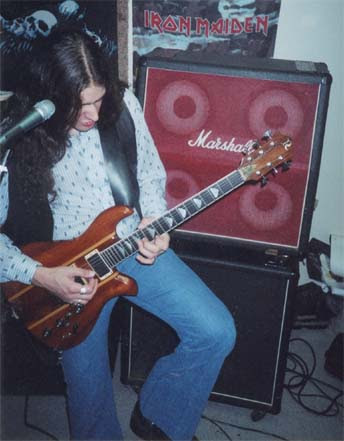
Perry with his B.C. Rich Eagle Supreme & Marshall stack at the Artisan jam room, NoHo, CA - 2003
The Story Behind the Cover
At first we wanted to keep with the Cirith Ungol tradition of using art depicting Michael Moorcock's albino elf anti-hero, Elric. We approached artist Robert Gould to see if we could license the cover of The Elric Saga Part I. It suited Falcon, as it depicted Elric with a bird of prey on his shoulder. At first Gould seemed interested, but eventually he just gave us the cold shoulder.
Full color scan of Michael Moorcock's Elric of Melnibone by Robert Gould
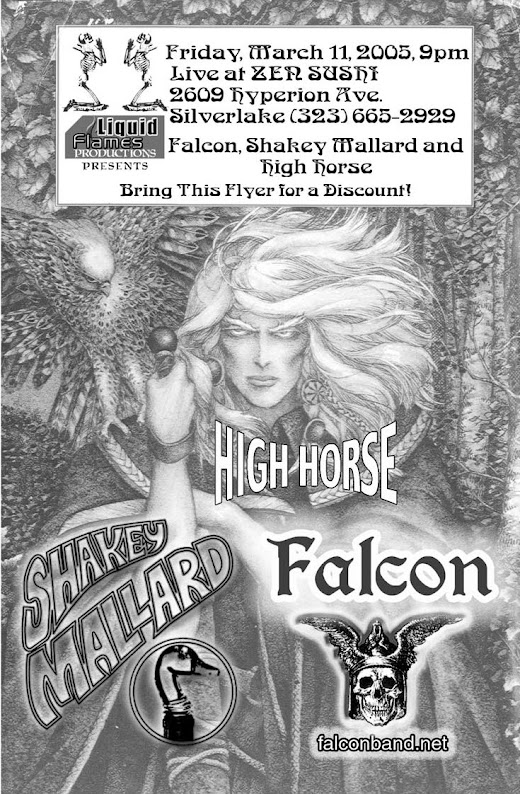
Perry's b-day gig in '05 with Shakey Mallard & High Horse. Get your sushi 'n' rawk on!!
The S/T Nitzinger LP cover
It wound up better that way, as I discovered the perfect cover in a pen and ink piece by renowned fantasy artist Virgil Finlay. Finlay's illustration is of a skeletal warrior on a beach surrounded by seagulls. Being that I worked in graphic design/advertising, I chopped the skull out of the larger artwork, leaving the winged helmet in as well. The result was not only an album cover, but the perfect colophon/logo for Falcon. I quickly got in touch with Finlay's daughter through an old weird fiction friend, editor Joe Wrzos, to secure rights. From that point on the helmeted skull graced nearly every Falcon gig flyer. The final cover is a combination of Finlay's finest and a backdrop of black leather amp leather or Tolex and the logo in silver embossed foil stamping as on the self-titled Nitzinger LP (1972).
The infamous first Falcon gig flyer!
Track by Track Notes
1. Downer
This one isn't about popping pills. Quite the contrary, it's a philosophy. Taking things raw, without a crutch, heeding "the worse case scene". There's also a politically charged bent to the lyrics. The "banished utopia laid to waste before its time" serves the purpose of having a bite at Uncle Sam. Riff-wise, there's a little tidbit about the intro/outro worth mentioning. Rob Garven, the Cirith Ungol skinsman, said, upon receiving his copy of the S/T Falcon album, "It reminds me of Heart's 'Barracuda'. It wasn't a conscious effort. Just something that occurred by chance. I've always felt it owes more to Pentagram (circa Day of Reckoning) and Quartz (think Stand Up and Fight) than anything else. Greg played the honky tonk piano synth in the solo section of this one.
2. Castle Peak
Castle Peak is a mountain wedged between my old suburb (West Hills) and the ritzy gated community Bell Canyon in sunny Southern California. I hiked it many a time during my early teen trials and tribulations. Climbing Castle Peak cheered me up when I was down, prior to obtaining my very own electric axe. On the lower slopes of Castle Peak there's a cave, fondly referred to as the Bat Cave by the teenage heshers who used to hang out there. Castle Peak was used as a ceremonial site by the Chumash during the solstices, The Cave of Munits – which lies in direct sight of the rocky peak, was said to be the home of a powerful Chumash shaman who was killed after murdering the son of a chief. There are stone alcoves at the summit of Castle Peak. In and near the alcoves were heaps of of heavy rock 'n' metal graffiti. Back in my high school days (daze) there was spray-painted the likes of Iron Maiden, AC/DC and Metallica. Before these sprawling trails were officially preserved as parkland there was an overzealous security guard patrolling this parcel of land, formerly called Ahmanson Ranch. The rent-a-cop brandished a gun loaded with rock salt. Fortunately I was never caught by the guard, although I know others who were shot at and detained. All that nonsense came to a halt in 2004 when the Victory Trailhead, El Escorpion Park and the rest of the former Ahmanson land opened for public use. For once the politics of land/property development sided with the nature loving common person. I was stoked to the max and celebrated the cool situation with a trip to ye old Bat Cave.
Philip Parris Lynott - the original Rawker (1949-1986)
3. On the Slab
"On the Slab" is my tribute to Phil Lynott and Thin Lizzy. I'm heavily influenced by both the Eric Bell-era power trio and the classic lineup with the duelling guitars of Brian Robertson and Scott Gorham. They're a special band for Greg Lindstrom too. He and Cirith Ungol drummer Rob Garven used to wear homemade Thin Lizzy t-shirts on their rounds of SoCal record shops like my old hangout, Moby Disc in Canoga Park. The title stems from the story of the same name by Harlan Ellison. "On the Slab" was Ellison's paean to H.P. Lovecraft. This one's rooted in reality rather than fantasy. It's painfully obvious that this tune is a tale of a smack addict going down the drain on drugs. It could just as easily encompass blow and meth as well. (As in "inhaling your death off a slab".)
Bobby Liebling, the voice of Pentagram!
Ironically, "On the Slab" has guest lead vocals by none other than Pentagram's Bobby Liebling, himself a storied smack and crack addict for the majority of his life.
I originally laid down vocals on both the demo and album versions of the tune, but I just wasn't happy with the results. As the vocal tracking came to a close it was evident that I'd either need to revisit it or... The possibility of Bobby coming in to lend a hand - or pipes. Bobby previously made a guest spot on Pale Divine's Thunder Perfect Mind, on the tracks "20 Buck Spin" (a Penta-cover) and "Dark Knight". So, it goes without saying that both drummer Darin McCloskey and engineer Chris Kozlowski were friends of Bobby's already. The latest version of Pentagram (with the 3 instrumentalists from Maryland doom kingpins Internal Void) was finishing up tracks for the Show 'Em How album, also with Chris Kozlowski at the helm. Kelly Carmichael (guitar) and J.D. Wiliams (vocals) from Internal Void paid a visit to us while we were recording overdubs. At Chris' recommendation I left my lyrics sheet and a note to Bobby with my cell phone number. I didn't expect he'd want to sing it due to the too close-to-home theme. On the contrary, Bobby rang me up and raved about how authentically Lizzy-like the tune was and that he'd be very happy to vocalize a tribute to our and his big hero, Philo. Bobby rang me several times, even during the wee hours of the morning. He left me messages to show me how he wanted to sing parts. We had some good phone chatter. In the end, we were thrilled with Bobby's rendering. Bobby went off the rails again around the time we released the S/T Falcon CD. I called him and he nodded off on the phone. A while later he screwed over the Internal Void guys by collapsing on stage at their first (and only) gig before a note was even played. Hopefully he's doing better now than he was back in '04. To this day I’ve never met Bobby, but we had some good long talks on the phone, and I hope to see him live with Pentagram someday.
4. The Crying of Lot 246
The title of this one is a play on Thomas Pynchon's 1965 novel The Crying of Lot 49. Thematically it's slightly similar to "Castle Peak". "Lot 246" also has something in common with Grand Funk Railroad's "Save the Land". It's about conserving land, lashing out against greedy commercial/corporate property developers. Getting back to nature. That sort of thing... Both Greg Lindstrom and I are big fans of Cream, and the chord progression in the chorus of "Lot 246" brings to mind "Tales of Brave Ulysses". Chronologically, this one was the second track I wrote for Falcon - also the second I demoed with a drum machine in autumn 2002.
5. Throwback
For the most part, "Throwback" is just a let loose and have fun type of song. I still managed to inject some seriousness into the fray. The lines "They watch my heroes die / Public eye don't cry" imply that the media doesn't care about the passing of talented musicians. Like say Chuck Schuldiner of Death and Control Denied fame. Randy Palmer (Bedemon, Pentagram) is another that comes to mind. The rest of the lyrics deal with the uninitiated not understanding the world of heavy rock and metal. Claiming it's too loud and "evil" sounding. Let's not forget all that demonic imagery. When I sang "I'm a throwback, baby / Born too late," I was quoting from the Wino-era Saint Vitus classic. I dig stuff that people call dinosaur rock (say Pentagram again!), I let my freak flag fly (the hair is flowin'!) and I love playing through a blaring full Marshall stack. Another Pentagram-related lyric is "livin' in a ram!" (as in "Living in a Ram's Head").
Leisure Suit Perry in front of the guitar cab shed at the Polar Bear Lair, Nov. 2003
6. Redman [Bang cover]
Bang is one of my all-time fave early heavy '70s bands. I'd call them proto-metal because of that outright heaviness.. They had three albums out on Capitol Records between 1972 and 1974. This one was on the self-titled Bang LP (1972). My old pal Rob Preston (Doomed Planet Records) hipped me to Bang. And they were the first band I wrote about in the pages of Metal Maniacs when I became a staffer in 1999-2000. Not only did I interview drummer Tony D'Iorio, but I became friends with Frank Ferrara (bass/vocals) and Frankie Gilcken (guitar) as well. We hung out one night in Hollyweird in 2000 and also in the studio in 2002 while they were demoing new songs. After the studio visit we adjourned to their friend's Calabasas home. I love the hippie-esque theme of "Redman" - again, a cautionary tale of not allowing the land to be raped by the Man and his penchant for war. Live, Falcon used to lengthen our version of "Redman" with an extended improv jam. Technically speaking, Bang tunes down a half-step (a semi-tone in the UK or Oz) to E-flat, while we tuned down a whole-step to D. This makes it easier on my voice and also adds a bit of heaviness to the whole affair.
7. High Speed Love
"High Speed Love" is an old Cirith Ungol tune from the late '70s. Greg wrote this fun little tune about fast cars. Both Greg and Rob Garven are big car racing fans. They love Ferraris and the like. I've never been much of a car geek, but I can understand their obsession with speedy automobiles. Tim Baker sang the original with backups by Rob and Greg.
8. Route 666
Another one of Greg's old Cirith Ungol songs which they demoed in the mid '70s. Greg wrote both the lyrics and music - and sang the original version himself. It's a horrific tale of a guy who comes face to face with a demon on a lonely desert highway. I had Greg's vocals to base my own delivery on thankfully.
9. Shelob's Lair
Fantasy geeks might realize right off the bat that this is Greg's take on J.R.R. Tolkien's Lord of the Rings. Like Zeppelin, Rush and Mountain before them, Cirith Ungol used the hippie's fave fantasy series for song fodder. Shelob was the giant spider who tangled with the heroes of the story in Cirith Ungol. Cirith Ungol was the high mountain 'pass of the spider'. Other Tolkien bits Greg inserted into the lyrics were the Ringbearer (Frodo the Hobbit), Samwise (Frodo's Hobbit friend), the Nazgul (Ring wraiths) and the magic sword called Sting. A rehearsal recording sans vocals was my only guide in how to sing/play "Shelob's Lair". I tried to deliver the lines as Tim Baker (the CU vocalist) might have.
10. Half Past Human The subtitle of this one was "A Quarter to Ape". The final S/T Falcon track is Greg's tale of the demise of man on Earth. Cirith Ungol demoed it in the mid '70s. He was heavily influenced by the fantasies of Jack Vance (The Dying Earth) and perhaps a hint of Clark Ashton Smith's tales of Zothique as well. Again, I had no vocal guide to follow beyond Greg's coaching. I tried to instill a bit of Iggy Pop into the line "Thirteen screaming souls / to feed the one within".
A sad day for metal, and a bad blow for me personally. Today I lost a close friend. And we lost a true talent, singer Michael D. Grant III, of Crescent Shield, passed away at 39. Mike’s melodic baritone voice graced pro recordings by Legend Maker, Onward and finally Crescent Shield. Sure, he was a singer, but he was also a gifted lyricist and songwriter. Even though he didn’t play an instrument, Mike would sing or hum guitar and bass lines or drum parts. His passion was music, particularly heavy metal. Acting was his other forte, and he brought that theatrical flair with him to whatever he sang, especially on stage. Acting out the lyrics with all sorts of motions and gestures! CS or “The Shield” was his true calling, the band he formed with comrade in arms Dan DeLucie before Destiny’s End folded. The pinnacle of Mike’s career was performing with “The Shield” at the Keep It True open air festival in Germany in 2008, and the footage is the proverbial proof in the pudding that heavy metal is missing one of its great frontmen.
MDG III and me at the Anaheim Destiny's End/Nevermore/Iced Earth tour gig - 5/14/99
Personal memories? They’re many and far reaching.
I first
met Mike Grant at the House of Blues in Hollywood
at an Yngwie Malmsteen concert in late 1995. Mike had recently relocated to L.A. from Connecticut.
I was wandering around outside the venue before the gig when I saw this dude
wearing a Forbidden longsleeve. Though I was a lot more reserved back
then, I went up to him and remarked that it was good to see someone flying the
flag of such a killer technical/melodic and traditional metal band in those
barren times. Mike instantly opened up, a super friendly guy, and we had a long
chat about all sorts of favorite bands we had in common (Savatage, Sanctuary,
Fates Warning, Queensyrche, etc.).
I then asked the question I’d been reserving for last, “So,
do you play an instrument?”
“No, but I sing!” was Mike’s reply.
And he wasn’t
lying—unlike the usual L.A.
wannabes—I’d find out later. Mike’s instrument was his voice, and he used it to
show instrumentalists what he heard in his head to orchestrate a song.
I didn’t get Mike’s number at the end of the Yngwie show,
but we said we’d see each other at the next metal gig. And, rest assured we
repeatedly did at nearly every club imaginable in the SoCal area. I kept
badgering Mike about using his vocal services. At first for the band I was
forming in 1996 with Mike Bear (bass), and later for my own project (Obscure),
but somehow we never recorded a note together, nor played a gig in the same
band. We shared the stage in different bands and watched each other
perform countless times, egging a metal bro on from the front row. Oh, but we did
jam many a time, off stage – in the rehearsal room or at home. It was during
those many jams that I witnessed firsthand the enormous talent and larger than
life personality that was “MDG III,” as he was referred to for short. The
skill! A great pair of ears and pipes! Naturally precise pitch, emotionally charged delivery and a keen ear for
what each instrument could accomplish towards the greater whole of a song.
While L.A.
is a massive metropolis, and tons of superficial people abound, Mike was a
no-bullshit type of guy you could depend on – never so self-absorbed that he
forgot to ask you about your life. Always willing to help a friend in need!
Mike was always struggling to make ends meet with “day jobs,” like any aspiring
musician or actor in L.A.
One of Mike’s many jobs was as a manager in a photocopy shop, where he pitched
in to assist me in keeping my tiny publishing business (Tsathoggua Press)
afloat by sneaking in free or heavily discounted jobs. He could’ve gotten the
sack for it, but he went out of his way for a close friend.
Big city or not, L.A.
actually has a very incestuous little metal scene, and the same fans and
musicians are spotted from venue to venue. Everybody seems to know each other
or has answered a “musicians wanted” ad placed by a friend’s band and so on.
So, it wasn’t a big surprise in 1997, when I discovered that Mike Grant had
become pals with New Eden guitarist Dan DeLucie and his sister Linda
simultaneous to me, bassist Mike Bear and Prototype guitarist Kragen Lum.
Friendships were solidified then that lasted – far beyond any of the
stereotypical L.A.
facade – for well over a decade. A close-knit circle of metal friends, a “metal
posse” as Mike Grant’s cohort in “The Shield,” bassist Mel Sisneros, called it.
MDG III was definitely one of the blazing personalities in that ring. He kept
us amused by acting out all sorts of goofy scenarios on our various outings. It
was rare that our Mr. Grant ever missed a chance to hang out with the whole
group of metalheads. And for a good several years I probably saw MDG III at
least once a week, despite the fact that he lived in the heart
of L.A. proper, while I was on the western edge
of the San Fernando Valley.
Mike, being of a thespian bent (he was a born actor, I tell
ya!), was a total film fanatic. It was the second thing he loved after his
metal. One of Mike’s many jobs was hawking promo tickets to advance screenings
of new movies. He was always hooking his friends up with free passes, or
accompanying them to theaters all over the “southland,” as the newcasters like
to call El Lay. One of the funniest episodes of my friendship with Mike
revolves around the flick Cube. We
saw it near his old Miracle Mile pad at the BeverlyCenter.
The premise of the movie revolved around a group of amnesiac people imprisoned
within a booby-trapped maze, rigged up with all sorts of treacherous
contraptions to slay its human occupants. None of the prisoners knew why they
were ensnared or how to exit the cube of the flick title. Mike and I followed
the arrows and signs, exited the mall to the multi-storey garage. We headed
straight for the level and section where he’d parked his little black Honda.
Only to find the bloody car was missing. We proceeded to check every level of the
garage, but... No cigar! Figuring the thing was stolen, we headed back into the
mall to flag down security, only to both smack ourselves in the head for our
own mistake. We discovered that the flick had put our noggins in such a spin
that we neglected to realize there were two garage towers on opposite sides of
the mall. Go figure! The movie had achieved its desired mind-fuck, and we
laughed our asses off the entire way back to Mike’s place.
I mentioned jamming together... It was my pleasure to play
heavy-ass metal with good pal Mike for nearly a couple of years, between 1998
and 2000. You see, our singer in Destiny’s End lived in Texas, while we four instrumentalists were
in La La Land. Mike not only loaned us his stereo power amp the few times that
our singer was actually in town, but... He also sang for Destiny’s End during, by my estimate, upwards of 100
rehearsals. Reason being? We wanted to be well-rehearsed with a vocalist for
gigs. Also, guitarist Dan DeLucie and I wanted to give Mike a chance to keep
his voice in shape for his own efforts. In Destiny’s End rehearsals Mike fit
like a glove, and I honestly felt like he was a member of the band. As I’ve
stated previously here, there were many times when I wished he had been our DE
singer. He was honest, dependable, down-to-earth and always enthusiastic about his beloved metal.
There were other jams, though! A metal family consisting of me, Mike
Bear (then in Prototype), Ana Greco (then in Rapture and Faustus) and Mike
Grant (then in Ocean Seven) often fooled around with tunes on our time off from rehearsing with our
respective bands. Mike cracked us up by mouthing what he felt was the most
cliché riff from his
first-ever band back in CT (Morpheus), forcing us to play it. I’ll remember that silly
ditty till the day I die, I think, thanks to Mike’s antics.
On a couple of occasions, I loaned Mike (and Dan DeLucie) the
use of my multi-effect unit to put delay and reverb on his voice for Onward or
early Crescent Shield demos. I was the first person outside of Dan who heard
the demo of “The Waterfall Enchantress,” and it just floored me. The hairs on
my arms were standing on end. Mike had succeeded in transforming what was
previously just Toby Knapp's instrumental metal track (Onward had no identity yet) into a riveting and heart-rending
journey. You could sense he felt every last line he sang. No going through the
motions for Mike!
Though Mike and I hadn’t seen each other in a while (we last
hung on my second to last L.A.
visit in April ’09), we kept in touch online. In our last chat he seemed to
upbeat, coming out of the gloomy aftermath of his long-time girlfriend Sue
Lee’s untimely death in 2011. We spoke about working on something musically together in
the near future. He asked me to email our mutual pal Dan DeLucie to get the
ball rolling. I’m crushed to say that’ll never happen. I’m left pondering what
sort of metal magic that triumvirate could’ve wrought.
I suppose I’ve got to close this out. I have a wealth of
fond memories of hanging out with Mike, which is a small consolation for not being able to grow old with him. To be old farts singing classic metal tunes
on the fogy farm! I speak for all of Michael D. Grant III's friends, when I say “Rest in peace
brother! You’ll always be on our minds…”
Crank up some Onward and Crescent Shield Mike's honor, and
when you’re done with that, spin some Savatage, Fates Warning and Sanctuary! I
know he would’ve liked that…
Here's some video footage of me bangin' the bass for Pennsylvania-based heavy doom rawkers Pale Divine at the Doom Shall Rise III festival in Goeppingen, Germany (April 16, 2005)! The tune's called "Amplified," off Thunder Perfect Mind, the first PD album. Cheers to Darin McCloskey (also my drummer in Falcon) and Greg Diener for the opportunity to tour with one of my all-time fave bands!!
A day after what would have been Chuck Schuldiner's 45th birthday (May 13th!), I was interviewed by Freethought Radio's Alex Fidel, as part of his celebration of all things Chuck, Death and Control Denied. We talked about my articles "Precious Memories of Chuck Schuldiner" and "Things Seemed So Eternal: 12 Years of Infernal Death," meeting up with Chuck, Death and Hammerfall in Dec. 1999 and the state of heavy metal on mainstream radio. You can download the entire Chuck Schuldiner 45th Birthday episode by clicking here. Or, you can cut to the chase, and download the short MP3 of my intie alone by right cicking here and selecting "save as."
Chuck Schuldiner - live at the Whisky in Hollywood, CA - 1/16/92
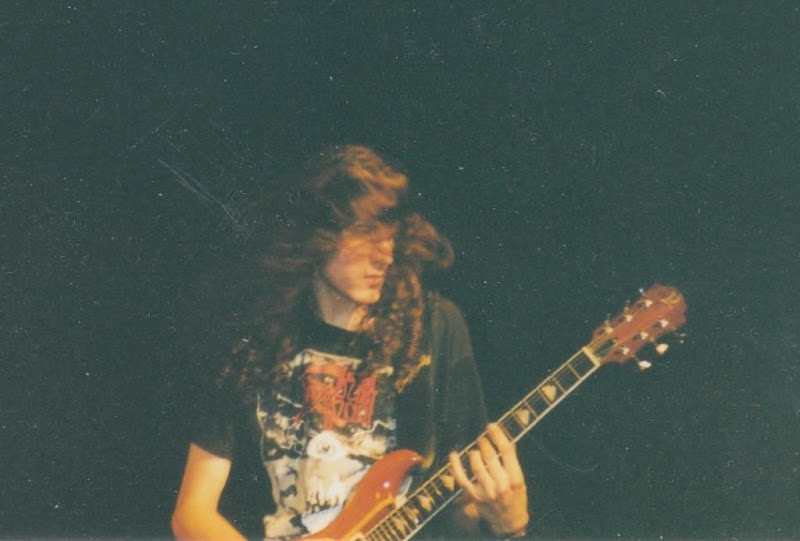
Sporting a Death - Symbolic logo shirt while opening for Mercyful Fate, Aug. 1999
James Copper of Death in HD posted Alex Fidel's Freethought Radio interview with me on YouTube. Check it out below or click here to go to directly to the video page. The intie focused on all things related to Death, Control Denied and Chuck Schuldiner, including my liner notes to the forthcoming reissue of Death's Individual Thought Patterns.
[18 August 2011: This post is under heavy construction. It was a herculean task I've been undertaking over the past several months. I will be adding more links, photos and correcting errors. -P]
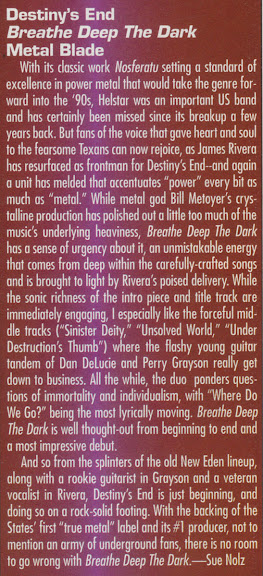
Now it’s time to tackle Breathe Deep the Dark (1998) itself. Before I go any further, let me just say that I feel it personally necessary to post the audio of Breathe Deep, as it is currently out of print on CD (and was never released on vinyl). As it's unlikely I and the other former original members of Destiny's End will ever see any mechanical royalties based on "album sales," and Metal Blade has clearly not done right by us (they haven't even bothered to issue us a statement since 1999), I think it's imperative to post the entire album, plus the previously unreleased "Japanese bonus track," here and encourage all my fellow metal fans to download, share and enjoy the tunes! Why not? Tons of "pirate" sites already offer Breathe Deep in inferior quality and without the true inside story or all these rarities and ephemeral paraphernalia. What you read and receive here is "straight from the horse's mouth," so to speak.
Breathe Deep the Dark cover by Rainer Kalwitz
El Niño in Noho
It was an unusually wet SoCal winter when DE entered Bill’s Place Studios in North Hollywood, CA to cut Breathe Deep the Dark. Bill’s Place was ordinarily a rehearsal facility operated by Warlord and Fates Warning drummer Mark Zonder. The name Bill’s Place doesn’t refer to in-house Metal Blade engineer Bill Metoyer. Bill was actually Mark Zonder’s favorite pet cat. An industrial carpeted long hall flanked by several full-size rehearsal rooms on either side. Zonder had recently built a small recording facility in the front part of his building. Why Bill’s Place then? It was affordable and local.
Dan DeLucie and I dreamed of getting Death, Savatage and Crimson Glory engineer Jim Morris to record DE at Morrisound in Florida. Oh, how we both absolutely adored the sound of Death’s Symbolic! Travel and other considerations made Morrisound impossible. I even asked Steve DiGiorgio from Sadus if Scott Burns was still engineering. Steve’s reply? “Nope, he’s only doing projects for friends now.” Metal Blade decided that since DE’s recording budget was quite low that we’d have to keep it “in the family.” MB employee and house engineer Bill Metoyer was at the helm, co-producing with us, the band. No, we couldn’t record on analog 2-inch tape like me and Dan wanted. That’d cost more than a few of our bodily appendages. We were forced to record digitally on ADAT machines. In addition, it wouldn’t be possible to have James in L.A. to record his vocals. Bill flew down to Houston to track James singing his parts without any of the four instrumentalists in-tow.
Breathe Deep was my first “real” studio session. I’d only demoed music previously. Dan DeLucie, Brian Craig and Nardo Andi had recorded the full-length New Eden album Through the Make Believe a year prior to BDtD and had also done some semi-pro New Eden demos. Sure, I’d been in studios before. Like when I visited friend Steve DiGiorgio and Sadus up in the Bay Area while they recorded “Stronger Than Life” for a Mascot Records compilation album in ’97. I knew all about “scratch” or “guide” tracks, the term used for the throw-away guitar and/or bass played while the drummer records his keeper parts. Typically guitarists don’t worry about their tone while scratching. That sort of minutiae comes once the drums are fully captured. I was also aware from watching Sadude Darren Travis that most metal bands in the ’90s recorded their final guitar tracks in the control room with their amp and speaker cabinet(s) miked up inside a soundproofed studio room. I knew Solitude Aeturnus operated similarly from watching their Days of Doom home video. I didn’t expect anything different for DE. Well, I guess I was mistaken.
My memories of Bill’s Place are a pleasant shade of gray—Fates Warning pun intended! Yup, Fates Warning pervaded everything about Breathe Deep the Dark. Aside from the tracking I recall consuming tons of junk food, reading cool European metal mags while munching away and getting the chance to hang out with some musicians I admired. At Bill’s place, drab, padded gray walls and industrial grade carpet stretched for as far as the eyes could see. After all, I cribbed the song/album title from the Fates lyrics to “Island in the Stream”: “Breathe deep the darkness that drowns you / Let your imagination take you.” “Breathe Deep the Dark” was my affirmation of being a fantasy writer and musician and delving and escaping into the eerie, weird and cosmic depths of creativity. Breaking the mold of dull 9-5 existence and “normality. I was utterly ecstatic that Dan, Brian and James relented to my suggestion of Breathe Deep the Dark as the album title, and I felt as if I didn’t need to hold back any material for “solo” or outside projects at that time. I was allowed that space and encouraged to keep writing. We’d be lacking songs if I didn’t contribute, and it goes without saying that my bandmates all chimed in with their own material to compliment my riffage and lyrics. That changed somewhat between Breathe Deep and Transition.
First order of business? Track the drums over the course of a weekend. Brian Craig bashed the skins according to schedule. Due to the rehearsal room layout of Bill’s Place Brian’s drums were set up in a rear rehearsal room with a talkback mic transmitting his voice back to us in the control room. I compared memories with Dan DeLucie recently and my mind is not going like Hal 9000’s in 2001. Brian’s snare drum was triggered, which usually bugs me to no end. In this case it was okay, because Brian’s Pearl Export Series set was so beat-up and ancient that it was hard to get a good miked sound by itself. The recording is a combination of the triggered sound and the natural one, not a full replacement. Dan DeLucie and I played scratch guitar along with Brian, but we were in a side room. We didn’t program click tracks. Dan and Brian had worked out what tempos they wanted the tunes to be. In a word? Fast. Since the metronome wasn’t programmable, we inevitably went off the click after a minute or two. I dig that facet of Breathe Deep the Dark, as it’s only human.
HAL 9000 sez: "My mind is going..."
“Guys, I’m scared,” Bill said. He wasn’t joking. “I’ve recorded some of the drums at the wrong tape speed, and it isn’t a standard speed.”
Bill wasn’t sure he’d be able to convert the recording speed back to normal, and we were all worried that an entire three days went down the tubes. Within hours our fears were allayed. We collectively breathed a sigh of relief. Scratch tracks were tossed to the wind.
Bill kept us laughing throughout the Breathe Deep sessions anytime he made a bad move behind the board by shouting goofy obscenities— like “Cock!” or “Fuck me in the mouth!” —in true Tourette’s form. Our German labelmates and friends Sacred Steel found Bill’s antics so amusing they thanked “Heavy Weizen Cock” Metoyer in their first album liner notes.
Next up was Dan’s share of rhythm guitar. Dan and I both owned these super cheeseball Matrix guitar tuners. Probably not a good idea to rely on a sub-par cheapie like that, let alone base an album on its accuracy, wouldn’t you say?! A moving needle (true analog, folks!) told you whether you were sharp or flat. But Bill’s Place didn’t have any expensive strobe or rack tuners lying around, so that’s what we used. Prior to the Breathe Deep sessions I entrusted luthier pal Ed Laing with my B.C. Rich Warlock, Mockingbird and Seagull, Dan’s Carlos Cavazo model Washburn and Nardo’s Ibanez Soundgear 800. He adjusted the necks, intonation and fixed a busted volume pot in Nardo’s bass. (Again, unfortunately my Seagull bridge/tailpiece was cancerous by the time we hit Bill’s Place.)
Though both Dan and I brought our amps to Bill’s Place, it was my Boogie Mark IV that we used instead of Dan’s old Boogie Mark II-C (as in Colisseum). With Bill’s help we built a small speaker cabinet “chamber” or baffle out of carpet-covered studio boards. Again, since there was no space in the tiny control room at Bill’s Place, guitar and bass were recorded in a room halfway down the hall with a massive 1970s Sunn PA blaring in our ears. This was, in retrospect, a mistake. Still, Dan managed to wrap things up rather quick. He was done with his rhythms within 3 days. He tracked all his rhythms with his trusty black Washburn Carlos Cavazo model. Early in our friendship Dan remarked the Washburn had been his first guitar. I told him he was a lucky man, as it featured a set neck (glued in), unlike the large, awkward and clunky neck joints on my first two budget bolt-ons. I’ve always liked the additional sustain and easier access to upper frets you get from a set neck or a neck-through body. When it came time to do our leads, Dan sometimes switched to his white Joe Satriani signature Ibeenhad. I mean Ibanez. Sue me, I’m not an Ibanez man!
In a twin guitar metal band it’s generally a good idea to have the guitarist who wrote all or most of a song lay down their rhythms first. Metoyer even reminded us after we were done tracking, saying it was how he usually told bands to proceed. That worked out great on Dan’s end for “Rebirth” and “To Be Immortal,” for instance, but he was actually the first to record rhythms for my “Breathe Deep the Dark,” “Idle City/The Fortress Unvanquishable” and “The Obscure.” We both played varying parts in nearly every DE song, so it was entirely possible that there’d be discrepancies in notes. A sound bit of accessory advice I got from Mr. DeLucie just prior to the Breathe Deep sessions has remained with me to this day: it's advisable to use a full-size pick when playing extremely fast and technical metal. I used normal picks from the time I started on guitar until I was 20. Then I picked up an eccentricity in pick choice after joining short-lived Stormhaven with pals Mike Bear and Ed Laing in late 1995. Ed used/uses Dunlop Tortex Jazz picks, which are nearly half the size of a normal pick (Dunlop or other brand). At Ed and Mike's urging, I switched to Tortex Jazz. That lasted two years, until I came to the realization that a regular pick best suited my needs. With that added bit of surface area I was able to retain a firm grip and play faster.
L: Tortex Jazz M3 (.88mm), R: Tortex Std. (1.14mm)
I mentioned it was wet, didn’t I? That’s an understatement. NoHo wasn’t alone when it was blasted by Il Niño in January ’98. All of L.A. felt the deluge, including my guitars. During the basic tracking it hailed basketballs . A rare occurrence in L.A., though not Sydney. Wood and humidity don’t go together. My guitars revolted. My 1981 B.C. Rich Seagull neck nearly started to warp. I got jerked around by a supposedly pro shop when I had a major problem with the bridge/tailpiece on that Seagull, my then fave axe. Instead of simply telling me to go buy a replacement bridge/tailpiece for about $50, they slightly filed down a burr in the high E-string saddle on the cancerous original B.C. Rich Quad. After 15 minutes of playing the high E was dead as a doornail again. The Seagull was out of commission for 99% of BDtD. A real shame, because that Seagull is such a super thick, heavy and chunky axe—single cutaway, like a Les Paul.
In addition to being bummed about not having my ’81 B.C. Rich Seagull to record with, I was kinda nervous. Consider this: it was my first real recording studio experience. Nervousness led me to press down too much on the fingerboard. In effect trying too hard. Not good for keeping notes to correct pitch whether you’re technically in tune or not! Humidity likewise made my guitars go out of tune and misbehave. A gargantuan PA blared Dan and Brian’s tracks at me. I tell ya folks, I was frustrated and freaking out for a bit. I didn’t freeze up by any means, yet I wasn’t too thrilled with punching in a lot more parts than I originally expected. Perhaps that irked Bill some. Unlike other producer/engineers I’ve recorded with, Bill Metoyer isn’t a musician, so I’m not sure if he can see things from our creatively eccentric perspective. On the other side of the coin, I was relatively young and it was a valuable experience to be somewhat humbled in the studio. Bill’s been involved in a lot of historically important metal albums, and I suppose I’d have to say I worship the bands and albums he worked on more than I do the actualsound of said slabs like Fates Warning’s Awaken the Guardian (1986) or Trouble’s The Skull (1985). I dug hanging out with Bill, his sense of humor, the way he seemed dedicated to our project. But if I were to compare the BreatheDeep the Dark sessions to any other studio experience I’ve had, it would have to be the worst. Certainly I enjoyed everything about working with engineer/co-producer Joe Floyd more on our Transition album. Joe is a guitarist, and he brings a wealth of musical knowledge to the table. Likewise, his studio is chock full of amazing professional gear both vintage and modern. I’m not just considering the hodge-podge studio setup of Bill’s Place here. It was the whole Bill’s Place debacle, ya know? A cyclopean Sunn PA shrieking at you while tracking. Being spread out in different rooms across a big building. How ‘bout the nearly inaudible bass guitar? All elements that smack of an expensive demo rather than a serious debut album.
Steel Prophet bassist Vince Dennis worked at Bill’s Place and also teched for Fates Warning on the side. Vince offered me the use of his white B.C. Rich Gunslinger bolt-on. He’d gotten the Gunslinger off Fates Warning’s Jim Matheos when Jim switched to Paul Reed Smith. I wasn’t too comfortable with Jim’s axe, though it would’ve been an honor to use gear that once belonged to one of my fave metal guitarists of all-time. Anyhow, I buckled down and got to work with only the use of my 1983 B.C. Rich Warlock, 1980 B.C. Rico Mockingbird (a rare Jap neckthru) and 1992 Jackson Rhoads Pro (also a Jap neckthru, formerly owned by Prong’s Tommy Victor). Problems struck with the licensed Floyd Rose trem system on the Jackson. The Floyd went completely out of whack, buggering the action (string height for you non-musicians) and intonation. Ed Laing reminded me to stretch my strings thoroughly every time I changed ’em, but that still didn’t alleviate the Jackson issue. I fought the frustrations and ultra-fast tempos, but “Rebirth” and “To Be Immortal” were taking too long to track, so I caved at the suggestion of Dan taking over to record another set of rhythms for only those two. They were Dan’s songs, so he obviously had an easier time. Where there were harmonies or a varying second guitar part I had to show Dan exactly what I was playing differently in those two. Dan and I kept a watchful ear on Nardo laying down his bass. He needed a lot of coaching through notes to make sure he wasn’t playing out of key. Nardo’s right hand (pick) fingers were pretty fast, but his left required help. As in what note to hit when. Even with all this attention to detail we realized after the album was released that Dan was actually playing a note in the verse of “Fortress” a half step lower than I wrote and played my part. It’s played so blindingly fast that I doubt even the most anal retentive musician could tell.
When James showed up in L.A. during mixdown, he sniped at me. “Why didn’t you just let Dan track all the rhythms. You took too long. Andre [Corbin] let Larry [Barragan] do it in Helstar. Andre didn’t give a shit about anything but his solos.”
“Well,” I countered (this isn’t exactly word for word), “I care about my rhythms, ya know? Andre was a lead man. I’m not trying to be Mr. Yngwie von Shred. I write songs.”
Perry, Dan and James at Bill's Place while mixing Breathe Deep the Dark
DE was not a situation like the first several Metallica albums where James Hetfield cut layer upon layer of rhythm guitar by himself and left Kirk Hammett only his solo overdubs. Especially for “Breathe Deep,” “Fortress” and “The Obscure” to be heard correctly, my rhythm playing was required. Since the tunes were written with my personal idiosyncrasies, only I knew them to a “T.” I’m a reasonable guy, so I didn’t sit there and bitch forever about the fact that I should’ve been the first guitarist to track rhythms for the songs I contributed to DE. It is, without a doubt, harder to match an existing rhythm than record the initial one. So, I’m not overly bothered that those two DeLucie tunes only have my lead work on them. The 8 remaining songs are an equal split 50% Dan and 50% me for two rhythm guitar tracks on each side.
Truthfully, I didn’t lag overly much on rhythms save for those last two tunes of Dan’s. James got away Scot-free with the production of his vocals on Breathe Deep by comparison to the scrutiny of my rhythm guitar tracks. Instead of hearing Dan and I asking him to punch in a part he sang out of key or flat, all James had to worry about was finishing early so he and Bill could hit the Houston titty bars. He didn’t have any of us present in Texas to ride him about whether he was flat, sharp or even in the right ballpark key-wise over a certain riff.
The Decline 'n' Fall!
Daylight Metal Dreamers
Bill’s Place was a hive of activity while DE encamped for the Breathe Deep sessions. W.A.S.P., Steel Prophet and Fates Warning were rehearsing upcoming gigs or tours. One day I showed up early to the studio to find the place locked. Every metalhead’s fave Decline of Western Civilization II character, Chris Holmes, was waiting in the back lot. I parked next to his Frankenstein graphic white Chevy Camaro and tried to make small talk. Unlike some of the “legends” at the ’97 Metal Blade Xmas bash, Holmes actually spoke—a breath of fresh air! Holmes’ guitar amp was so loud that we often head him down the hall above the rest of W.A.SP. Affable Vince Dennis showed up after a spell and let us in. We saw Vince nearly every day. Sometimes he’d be joined by Steel Prophet axeman Steve Kachinsky. Vince and Steve were always very outgoing and friendly towards us, even when we shared the stage a few times in Socal and Germany. A brotherhood rather than a lame competition! While I was finishing up my rhythms, Flotsam and Jetsam drummer Craig Nielsen turned up. He walked down the hall and peeked into the “guitar room,” thinking there was a band rehearsing—with all that PA thunder. He didn’t realize I was tracking. Though I was neck-deep in my rhythms, I didn’t cop a ’tude or yell at him to leave. Believe it or not, I took a minute to say “Hey!” and explain what was happening. We regularly saw Craig everywhere around SoCal, while his bandmates lived in AZ. Craig was always keen to chat and was the Flotz dude I most bonded with. Flotsam and DE played together at the infamous Reseda Country Club to celebrate the release of Breathe Deep and the forthcoming Flotsam disc Unnatural Selection.
Steel Prophet axeman Steve Kachinsky
Steel Prophet bassist Vince Dennis
It was common to catch Mark Zonder in the wings of Bill’s Place. After all, he owned the place.
Warlord - Deliver Us
“Ugh, ’80s metal!?” Zonder voiced his disdain for traditional offerings while practicing drums for the upcoming Fates gigs featuring the entire “Ivory Gate of Dreams” suite off No Exit.
Remember, folks, DE was very much a melodic ’80s type prog/power metal band. On a personal level, I not only worshiped Fates, but Zonder’s previous band, Warlord. In my book, Warlord’s Bill “Destroyer” Tsamis was a purveyor of some crazily catchy riffage, heavily spiced with Greek melodies and tasty leads. To the point that I thanked Warlord in my Breathe Deep liner notes! Listen no further than the bridge of “Breathe Deep the Dark” to hear how much Warlord was an influence on me personally. I guess Zonder had “grown out of it.” It’s safe to say that I’ll never be too old to appreciate Warlord.
Rob Garven (Cirith Ungol)
Fates singer Ray Alder hung around the padded halls often. It took a while to break the ice with Ray. Where metal singers are concerned, Ray is one of my personal faves. Both then and now! It goes without saying that Ray and Fates were/are always higher on my list than James/Helstar. I related and identified more with Fates Warning’s music and lyrics. Always will! Agent Steel axeman Bernie Versailles, who was slated to play second guitar on the Fates A Pleasant Shade of Gray trek during the “Ivory Gate of Dreams,” “Guardian” and any other pre-Perfect Symmetry tracks, was another frequent Bill’s Place visitor. We got along with him well. I owned all of the Agent Steel LPs and respected Bernie’s ability. But as I’ve said previously, I sensed a sort of competitiveness with the other Fates guys (save for Jim). Maybe it was because they all remembered our singer James from Helstar. Perhaps they had some pre-existing issues? Did they feel Metal Blade was paying too much attention to DE? The reason is irrelevant. The fact remains that I was/am in such awe of Fates Warning. They were/are my favorite prog metal act, and I made it crystal clear any time I bumped into those guys that I was a massive fan. Fates began full band rehearsals while we were wrapping up the mixdown for Breathe Deep, and I finally met axeman Jim Matheos long enough to say hello. I wishI had time to rap over a beer with Jim, but there just wasn’t an opportunity. Frank Aresti and Joe DiBiase were no longer in Fates, but I was lucky enough to see them live at the Palace, Hollyweird, on the Inside Out tour in ’94. Joey Vera, who loaned one of his ADAT machines to Bill Metoyer for our sessions, didn’t really utter a word. Here was one of my big metal heroes from Armored Saint! I was kinda bummed. I wasn’t there to usurp anyone’s throne. To me Fates and Armored Saint are/were metal gods. I thanked them profusely in my Breathe Deep liner notes. Let’s get it straight, people, those guys run circles around me as musicians. I’m just a humble dude, and I’d already encountered down-to-earth musicians from well-known metal bands before I joined DE. (Rob Garven and Steve DiGiorgio are two that come to mind.) L.A. tends to be a city of attitudes and overblown egos. I’m not the first to make that observation, and I won’t be the last.
The last thing that we tracked before mixing began was clean-tone and acoustic guitars. Dan had a cheapie Washburn and I still owned this shite Applause roundback, a godawful entry-level version of Kaman’s flagship Ovation acoustic line. I remember the last thing I laid down was the clean electric intro to “Idle City/The Fortress Unvanquishable.” It required nearly absolute silence in a busy rehearsal facility. We were also agonizingly close to both Van Nuys and Burbank airports that planes overheard were killing the early evening session. Bill and I had to wait a while for Gary Gnu-nuers Spineshank, complete with their massive rehearsal budget, to stop playing in the room next door —not to mention the planes to die down. I was mildly vindicated in playing my beloved blue ’81 B.C. Rich Seagull for that itty-bitty clean part. We felt very accomplished with all tracks “in the can.”
Double or Nothing: Mixing, Mastering and Low-End Lameness
Mixing Breathe Deep took ages. Bill Metoyer finished a first mix within a couple of weeks. Dan and I were present every day too, but Metal Blade balked at it. Brian Slagel took it upon himself to guide Bill through a second mix. Again, Dan and I were at the studio every day to voice our opinions, explain what effects were needed where/when and to make sure no important tracks were omitted. I kept emphasizing how I loved the ultra-wet and slick sound of Andy LaRocque’s solos. We even exhaustively delved through Bill’s library of sound effect CDs to pick a few to use in song intros.
We had plenty of contact with Mike Faley, but it wasn’t until Slagel came down to remix that I was fully acquainted with the MB CEO. Slagel and I got along like a house on fire from day one in the studio. I babbled incessantly about cult metal bands. Slagel asked me what the hell “unvanquishable” meant. I had to tell him it was a synonym for invincible.
A silly little Fates/Metal Blade anecdote: I told Bill Metoyer that Awaken the Guardian was probably my fave album he engineered. In rambling about the Fates disc and John Arch’s distinctive voice and idiosyncratic (but nonetheless killer!) lyrics, I started talking about the final song, “Exodus.” Bill cracked a wicked grin and said, “You know Slagel still thinks he sings, ‘Exodus ice on the plain' in the chorus on that one.”
“Yeah, but… uh… it’s ‘ascend the plane.’”
Dan and I loved the trippy phasing effect in the fade-out at the close of Fates’ “Exodus” so much that we instructed Bill to do something similar with the end of “Where Do We Go” on Breathe Deep the Dark.
During Slagel’s mixing stint at Bill’s Place repeatedly asked him to tell me about the days of yore or just got his opinion on Cirith Ungol, Fates, Trouble, Warlord, Torch, Candlemass, Diamond Head, Thin Lizzy and the like. I’m sure I mentioned my Pentagram mania, and I don’t recall Slagel being the least bit interested. All considered, Slagel was affable towards me and the DE guys, and he promised to hook me up with a bunch of classic Metal Blade vinyl that was missing from my collection.
In hindsight—which I’ll remind you is always 20/20—Slagel’s presence further sucked the bass guitar right out of Breathe Deep. That’s not a reflection on how we initially bonded with Slagel. It’s just sonically speaking. There are several isolated spots when you can hear Nardo’s bass, but those are largely the “solo” sections on “Unsolved World” and “Under Destruction’s Thumb.” Dan and I were too awestruck and caught in the heat of the moment to voice our concern about Nardo’s buried bass. We learned our lesson though, making sure to speak up about the importance of bass with engineer Joe Floyd during the Transition sessions. The result? A warm, fat bass tone and presence that cut through in even the thickest sections of guitar. The Transition budget also allowed me and Dan to be present while James tracked his Transition vocals. On the quality-control side of production, that was something we were especially keen on. On a personal level, it meant being around the cause of much internal strife in the DE fold. Transition was still in DE’s future, so I now return you to your regularly scheduled Breathe Deep broadcast.
We wasted nearly an entire day combined on a song which was left unfinished during the Breathe Deep sessions. Nardo brought about 50% of a tune in towards the end of ’97, calling it “Symbol of the Soul.” I helped him finish it, but none of us liked the title or the lyrics James wrote. I toyed around with an alternate set of lyrics, "Demise of a Lie,” but it suffices to say neither set of lyrics would've flown in DE. James’ was too religious. The other anti-religion. If my memory hasn’t completely Swiss-cheesed, we never demoed “Symbol.” At Bill’s Place we actually tracked drums, rhythm guitars and bass, then abandoned it. Truly a “lost” DE track! I’m not even sure if it is on the multi-track ADATs or if said tapes exist any longer. What does exist in terms of Breathe Deep rarities is “Thief of Life,” which we meant to be our Japanese bonus track.
Breathe Deep wasn’t just mixed twice. It was mastered twice. Overkill? Slightly! Once at Future Disc by Tom Baker (no, not the Dr. Who actor), then after Slagel decided he didn’t like the job he handed it to Eddie Schreyer at Oasis . (Going over budget on mixing and mastering inevitably meant DE would have insanely hefty “recoupables” to surmount before Metal Blade would ever even entertain the thought of paying mechanical royalties to us. Non-existent “mechanical royalties” is a better term, I’d say.) I was there on both occasions, so were Dan and Slagel. I was exceedingly involved with each step of the album’s production, striving for a polished and professional approach. Hell, you might even call my preoccupation with recording analretentive. That’s fine by me. The Breathe Deep master cassettes made the jump with me across the globe from SoCal to Sydney. I actually ripped the studio version of “Thief of Life” directly from the Oasis master cassette in 1999 while I was still residing in ye olde San Fernando Valley.
Aliens, Hearses and Eccentric Lensmen
A rare parking lot shot in Slimy (I mean Simi) Valley, CA
Angus Scrimm, Phantasm's Tall Man, goes balls out!
"You play a good game, boyyyyy!"
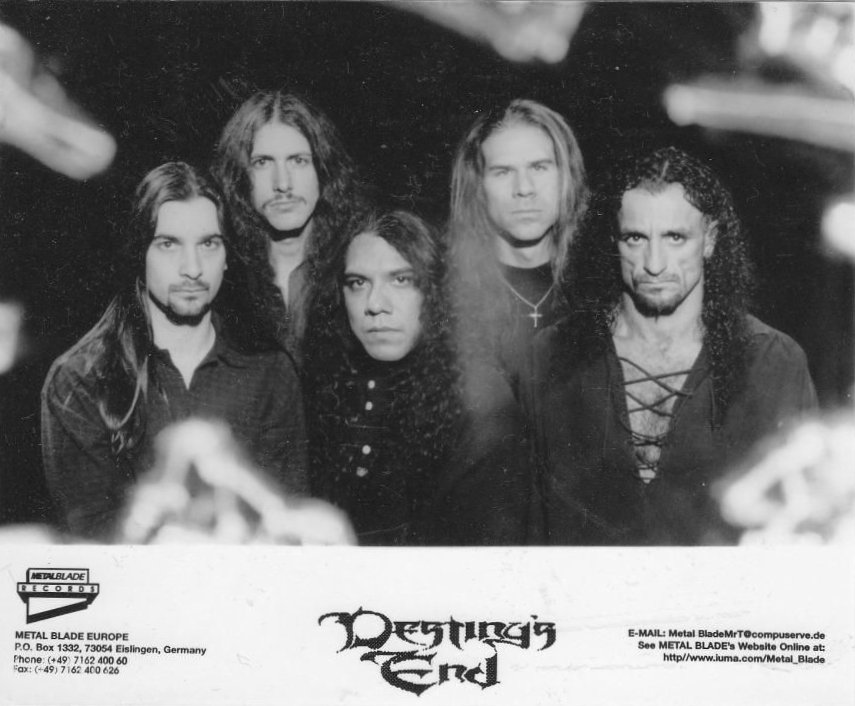
Lensman Alex Solca was hired to shoot Destiny’s End photos for the Breathe Deep the Dark packaging and promo material. Alex is a spritely artistic and eccentric chap who drives a hearse and is extremely passionate about his photography. Alex got some spiffy shots of us at the Metal Blade warehouse, including one of us with a blue broken glass gel overlay (which was used as our European 3x5 promo glossy). We had our guitars and took some individual shots too (which have never seen the light of day). Then, at my suggestion, we did a second photo shoot—this time at night. Stoney Point, near the northern edge of Chatsworth and Santa Susana Pass, was the location I had in mind and heart. The DE guys and Alex were eager to use the place based on my description. We drove out at night, with only sparse moonlight to guide us. Alex roared along in his gray Cadillac hearse. I half expected Angus Scrimm (The Tall Man from Phantasm) to pop out of the machine when we stopped. Or a brown-robed dwarf zombie from the coffin bed instead of the tripod and lighting rig. Stoney Point is a massive mound of boulders perched on the south side of the 118 Freeway on the borderland between Simi Valley and Chatsworth. I passed by that hilly area a lot until I left LA for Oz. Far more appropriate to our ominous album title, band name, lyrics and general ethos! While we wanted to appear austere, we were anything but. Nardo kept saying that Alex’s multicolored lights must seem like aliens to hikers in the distance. Sure enough, a couple of intrepid climbers stumbled upon us.
The Tall Man and his Caddie in Chatsworth Park
The trippy blue gel and shattered glass overlay shot!
Photographer extraordinaire Alex Solca
“Greetings Earthlings! Take me to your leader.” I exclaimed.
Nardo had just watched Tim Burton’s Mars Attacks and started mimicking the Bug-Eyed Monsters, “Hat-hat! Hat-hat-hat!”
Destiny's End 8x10 promo glossy by Alex Solca - 1998
Color shot from Stoney Point, Chatsworth, CA
Our 8x10 U.S. promo glossy was our favorite of the close-knit group shots, while our one-sheet album poster pictured us perched on a massive Stoney Point boulder. I was seated with my hands folded, my eyes staring off in the distance as if contemplating the riddles of life, death and the universe. I can joke about it now, but I probably was experiencing deep thoughts. Alex developed both shoots as 35mm chromes (slides), and we borrowed them from Metal Blade to make our selections. A reflection on how dedicated to every aspect of the band and album we were: Dan brought a slide projector down to our rehearsal room, and we sorted through pix on a white sheet pinned to the soundproofed wall.
Destiny's End contemplating the ultimate riddles of the cosmos at Stoney Point
Overexposed b&w shot from Slimy Valley
Another overexposed shot from the Breathe Deep sessions with Alex S.
The album cover was another final item that required our attention. We settled on using German artist Rainer Kalwitz for our cover. We were aware that he’d done some stunning covers for other metal bands, and he was well within our artwork budget. Since the few existing pieces Rainer had for sale didn’t suit us, we commissioned him to come up with an original painting based on the lyrics to my tune (our title track) “Breathe Deep the Dark.” Rainer faxed us simple storyboard sketches of his cover and a second painting of the five DE members—like stick figures nearly. Fortunately Rainer is better at painting than storyboarding, and the final result blew us away. Well, Nardo and Brian thought they looked a bit cross-eyed in the tray card painting, but otherwise… The layout was tackled by Metal Blade’s usual guy, Brian Ames. I typed and proofread the text for our booklet. Dan and I regularly spent tons of time on the phone at our respective jobs conducting band business. Faxes and emails jumped back and forth. Dan and I pestered Brian with heaps of small corrections. For the most part the CD packaging turned out better than expected, especially the retrofit of the DE logo. The logo was originally rendered by Dan’s work pal. Our promo glossy suffered from a pixelated low-res scan of the DE logo and our one-sheet poster logo was also a tad blown-out. Because I was working in the graphic design, packaging and advertising field, I thought it looked shoddy, especially considering Metal Blade was supposed to be a highly respected big indie metal label. Frankly, we paid more attention to detail and were consistent with print resolution at my old job (primarily smut biz clients!) than MB was with the DE promo pic and poster.
Rainer Kalwitz's full Breathe Deep the Dark painting based on my lyrics - 1998
Inside traycard - Rainer Kalwitz's paint rendering of the DE members' faces - 1998
Solo Perry shot by Alex Solca
Perry, Nardo and James at Club 369, Fullerton, CA
Several months elapsed after Breathe Deep was finished before it was released. In the interim we played our first triumphant gig at Cardi's in Houston, TX (March ’98). Then a bummer show in Corpus Christi the next day. Our super cool SoCal debut was at Club 369 in Fullerton, CA, in April ‘98. Our album release gig with fellow Metal Bladers Flotsam and Jetsam occurred in September at the Reseda Country Club, the venue where I saw my very first local thrash/death metal gig at 15. Although I was working a “day job,” I was pretty much floating on Cloud 9 as far as DE was concerned. I was finally happy to be in a band that was recording and gigging professionally. Just because we were signed to Metal Blade didn’t mean that I had exaggerated expectations of grandiose touring plans, money, fame, hot groupies and all that nonsense. I remained firmly grounded. Of course I was pleased whenever somebody said or wrote positive things about DE, but I also went out of my way to befriend metalheads all over the globe as simply another music fan, rather than a musician. I often invited people down to see DE rehearse and into my personal life without copping the least bit of a ’tude.
April 5, 1998 - DE's first SoCal gig flyer, designed by Dan DeLucie
Dan, Nardo and Perry (Brian is hidden) at Cardi's, Houston, TX - March 1998
Me and the Eagle at the infamous Reseda Country Club, CA - Sept. '98
A happy camper in early '98 - wearing the first DE shirt with my 1976 B.C. Rich Eagle, shortly after buying it at Norm's Rare Guitars
John Bush circa 1991
A group of veteran headbashers – Armored Saint and Anthrax singer John Bush, journalist Bob Nalbandian and Tobe Baad – started a metal night club called Black Lodge. As metal was largely dead in L.A., it was held on Wednesdays. It didn’t deter me, though. I was bubbling with energy and thought of it as a genuine release from daily doldrums. At the first Black Lodge night Brian Slagel MCed and played “Idle City/The Fortress Unvanquishable” over the PA for the crowd’s enjoyment. He pointed me out on the floor and gave DE a massive plug. There was no denying that it felt great to receive that sort of attention from the CEO of Metal Blade and to have my tune blasting over the sound system. Slagel introduced me to my metal hero John Bush, who was very cordial instantly. Bush’s warmth was the total opposite of his Saint bandmates’ blow-off at the Metal Blade xmas bashes in 1997 and 1999.
“Man, Perry,” John enthused, “that was just a killer track!”
Gobsmacked! Here I was, a young and humble dude, and I didn’t expect John to say anything about the DE song, much less enjoy it. I would’ve just been happy if John said hello and thanked me for supporting Armored Saint. He did a lot more! He took me aside and spoke to me one-on-one as a fellow metal musician. I was pleasantly surprised and smiling like there was no tomorrow. I told John how much I worshipped Saint and loved his voice as well as the late Dave Prichard’s axemanship. Vocalist and metal bro Mike Grant joined me at Black Lodge, and we adjourned to the upstairs room to listen to DJ Will Howell (formerly an A&R dude at Metal Blade) spinning cult vinyl. I implored Will to play some Cirith Ungol, and he actually whipped out the Frost and Fire LP.
Helicopter hair - Reseda Country Club, Sept. '98
We four DE instrumentalists noticed after a gig or two that not having James in L.A. to rehearse with us could potentially be disastrous. Dan, Nardo, Brian and I were overly comfortable playing with no vocals whatsoever. No sung cues were needed. We knew the four of us practiced our collective arses off in L.A., but we couldn’t babysit James and make him do his homework. Sometimes we’d have an odd monitor mix on stage and not be able to follow James if he was behind or ahead of us—which happened several times. James came over to me at the start of the first verse in “The Obscure” at our first SoCal gig in Fullerton and whispered, “How does the first verse go?” I tried to alert the other dudes and feed him the first line. We wanted to exude tightness and professionalism on stage. So, as I pointed out in my previous DE entries, we decided to enlist our good pal Mike Grant to sing for DE at rehearsals. Having Mike at the majority of our jams completed a puzzle. DE was bereft of a crucial element with our singer living over 1,000 miles away. It got to the point where I felt Mike was an integral part of DE. I often had to explain to folks that Mike was just filling in for practice purposes only. On many occasions, due to drug addiction, ego and the resulting personality clash issues with James, I direly wished that Mike Grant could simply replace Rivera. Especially when James was arrested by Houston police on a drug related charge at the end of our May/June 1999 tour with Iced Earth and Nevermore. It was a rough contingency plan that Brian, Nardo and I talked about as we departed Houston for L.A. (Dan remained in NY for a few days with his family at the end of the tour.)
Coming back to Breathe Deep: I took an entire day off work so I could do radio interviews to promote Breathe Deep the Dark. Many of the radio hosts I chatted with were on the college level, though there were at least a couple of out of state FM stations too. I was fairly serious when I did interviews. A lot of interviewers asked me what it meant to “Breathe Deep the Dark,” and I answered by saying it’s a phrase that describes embracing one’s own individual and creative side, maintaining artistic integrity and not letting the masses dictate what is “cool.” Regardless of whether the art you create or find attractive is considered to be of a bleak or morbid nature. I also made it crystal clear to them that I felt Destiny’s End was a very literate and cerebral thinking man’s type metal band. That was my and Dan’s take on DE, at any rate. I know Brian Craig agreed. Nardo didn’t write lyrics, and as for James, he’d often throw double negatives into his lyrics (“You cannot take no more”) which left a sour taste in my mouth and didn’t bring a very thought-provoking vibe across. I don’t mind the odd double-negative in a beer-soaked bar boogie tune. Lynyrd Skynyrd? ZZ Top? Sure! But I felt they had no place in DE.
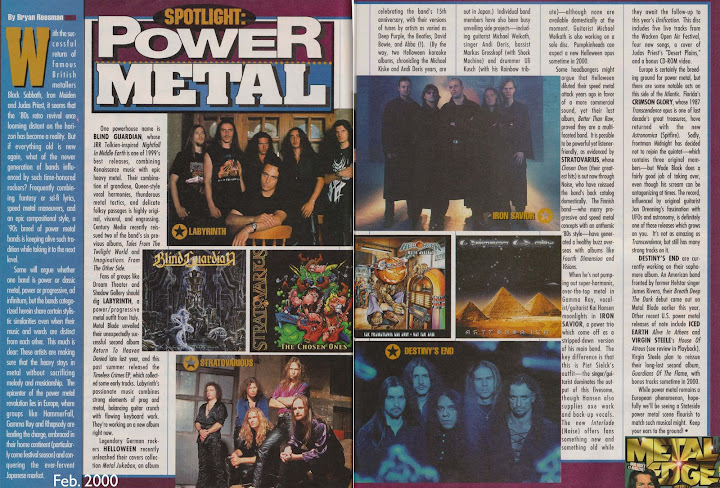
Metal Blade Germany flew James out by himself for a several day press junket. The four of us were a bit bummed that we couldn’t see Europe yet, but we thought it would do the band well to get some coverage in Germany and the rest of Europe. After all, metal never died there, whereas the U.S. was in a barren, dry spell. In reality, it was a double-edged sword. Some of the German journalists concentrated too much on James/Helstar worship than the current priority. Because Metal Blade snoozed at first on placing ads in U.S. metal mags for Breathe Deep, Dan and I did a lot of worldwide promo on our own. MB also claimed they exhausted their supply of promo CDs within about a month, so Dan and I got in the habit of copying cassette or CD-R samplers with a few songs on them to send to interested zines (both print and web) or stations. Our time, money and effort scored DE more press attention.
DE official "Metal Baldy" promo pack bio
I got a call out of the blue from my old friend, rock journalist and music biz veteran Jon Sutherland, who coached two of my high school friends in long distance running. Jon had been the Vice President of Metal Blade in the mid to late 1980s. I hadn’t talked to Jon for several months at least. As far as he knew I was still bandless.
“Perry, I’ve just seen your mug in Heavy Oder Was and Rock Hard magazines. You’re a star in Germany!” Jon exclaimed.
“Uh, not really a star, but thanks for the cool words,” I told Jon. I proceeded to tell him the tale of how I wound up playing in a band with Mr. Helstar vocalist.
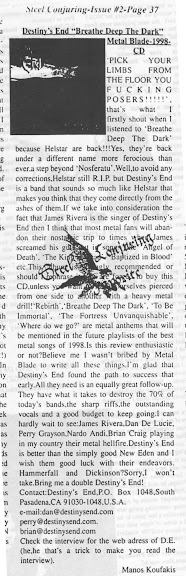
Manos Koufakis' Steel Conjuring review!
We also played a couple of dates in Texas with Mercyful Fate in August 1998 around the release of Breathe Deep. It was meant to be three gigs, but James bungled the business deal with the San Antonio promoter and MF’s tour manager. I previously covered this annoying fiasco in my entry on Transition. It wasn’t that we expected to get mind-blowingly awesome gigs opening for big bands like Mercyful Fate, but Dan, Brian and I were very concerned about conducting DE business professionally. When four of us had to travel to Texas to gig, we didn’t want to have hiccups and waste a bunch of money none of us had just because James couldn’t get contracts signed. Since DE had no manager or booking agent, we personally needed to get contracts and riders signed for any gigs (out of town or not). Handshake and verbal deals are flaky to say the least. James had been in the music biz far longer than any of us, so he should have worked everything out onpaper with the venue/promoter first. But… Nope!
Ill Literature DE interview feature pg. 1
Ill Literature DE interview pg. 2 (click on it to enlarge!)
Superstar Joey Severance
Metal Blade went through employees like toilet paper, and it was an uphill battle to get much done with all their topsy-turvy antics. Eventually MB employed an east coast chap, Joey Severance. Joey, now the singer of European metallers Tornado, absolutely adored Destiny’s End. If it wasn’t for Joey, DE may have achieved far less than we ultimately did in a brief 3 years. Joey worked his ass off for DE. I think Joey got sacked in 2000 as a result of his effort to help bands, as opposed to not moving a finger like his predecessors. We actually saw some ads in metal mags, a second wave of radio inties and were generally more visible. Joey wasn’t just a Metal Blade employee, he was a friend. We hung out both at gigs and in our spare time. He came down to DE rehearsals and I gave him a few guitar pointers too. Joey actually bought my old B.C. Rich Virgin off me before he bailed to Europe.
DE Magazine ad which appeared in Metal Maniacs and elsewhere
Sue Nolz's Metal Maniacs review of Breathe Deep
Metal Edge power metal feature, including DE!
Right click on the links below and "save as" to download the MP3s!
1. Rebirth - 3:56 (Lyrics/Music: DeLucie) James kicks this one off with a piercing falsetto scream, aided by a swirling flanger. We knew it'd be the opening track on the album and wanted to start off with a stunner. Dan wrote the lyrics, filled with in-jokes about New Eden and Helstar. "Returning from an empty eden" and "burning deep in the stars." It was about those guys having a second chance after Helstar and New Eden. An intensely fast DeLucie-penned track. I always thought the first riffs sounded like Swedish death metal (if we'd only tuned our axes down). Nope, in DE we tuned to plain ol' standard E. In retrospect, I’m not very happy with the second of my trade-off solos. I played rhythm guitar on the demo version of this track, however, Dan tracked 4 sets of rhythms on the album version, and I only played solos. See the “Il Niño in Noho” section above for more about that!
2. Breathe Deep the Dark - 6:00 (Lyrics/Music: Grayson) My second contribution to the band. It became the title of our debut album. Lyrically I was heavily inspired by H.P. Lovecraft ("The Outsider," "The Dreamquest of Unknown Kadath," etc.), Clark Ashton Smith's tales of the dying future continent Zothique ("Empire of the Necromancers," etc.), Edmond Hamilton's "In the World's Dusk" (note the line "Survived alone in the world's dusk") and M.P. Shiel's post-apocalyptic novel The Purple Cloud. The first line of the song is a paen to Rod Serling, creator of The Twilight Zone and Night Gallery, while the main riff betrays my love for Death’s Spiritual Healing LP. The chorus crunches a la Forbidden's TwistedintoForm. It's also safe to say I learned a few thrash techniques from my friends, Prototype. Originally there was only a single guitar part on the chorus. I don't ordinarily listen to fan suggestions, but we had a visitor at the rehearsal room who said the part might sound cooler if one guitar was doing something different. So, I wrote the arpeggiated second guitar part on the spot for a dash of spice. It follows the main chords, albeit in a higher register. The bridge is very Maidenesque, boasting a snake-charmer lead courtesy of Mr. DeLucie and Nardo’s Steve Harris-like walking bass line. My solo was pretty short and succinct, and marks the only time I ever used a tremolo bar on a lead part. (I haven't owned an axe with a trem since 2002). Brian Slagel said it reminded him of Fates Warning axe slinger Frank Aresti’s style of lead playing. That was another statement I took as a massive compliment, because Frank Aresti happens to be one of my top fave lead axemen in "modern" (meaning post-1985) metal. I always thought the vocal melody on the chorus sounded like Peter, Paul & Mary's “Puff the Magic Dragon.” Kinda nifty and different for metal. James usually sang a lot of his typical half-steppy melodies, but the chorus progression one forced him outside the box.
3. To Be Immortal - 3:28 (Lyrics: Craig, Music: DeLucie) Dan sure loved his Rachmaninoff and other classic composers, didn't he? A fast, galloping verse and a heap of harmonies. Drummer Brian Craig wrote the lyrics, about an emperor-type fellow seeking immortality through imperial conquest. Brian read legal thrillers a lot, and it was a shame he didn't write more DE lyrics. Between Me, Dan and Brian there were three exceedingly literate DE guys. Though I played rhythm guitar on the demo of this track, Dan tracked 4 sets of rhythms on the album version. See the “El Niño in Noho” section above for more about that!
4. Idle City / The Fortress Unvanquishable - 5:24 (Lyrics/Music: Grayson) My two-part epic with lyrics inspired by Irish fantasist Lord Dunsany's short story "The Fortress Unvanquishable Save for Sacnoth." Lotsa Middle Eastern melodies. Dan's harmonized opening solo puts the icing on the cake, and the rest of the lead work is mine. A conglomeration of various influences: Death, Savatage, Sacrifice, Testament, Dio-era Rainbow, Uli Roth-era Scorpions and maybe even a little '70s Al DiMeola. I laid the foundation for this one back in '95. There were a few minor alterations, but it's very close to how I envisioned the tune when I was 19-20. I tacked on the creepy clean-tone intro for the final DE version. Brian Craig helped slightly to nail the arrangement down.
5. Sinister Deity - 3:50 (Lyrics: Rivera / Music: Andi) This was an old New Eden song, formerly known as "The Hunger" on their Savage Garden demo. Instead of coming up with something completely new, James reused an old set of Helstar lyrics for it. That's the only relation it has to his other band. Inspired by Tony Montana in Brian De Palma's version of Scarface, it's about a devious drug lord who makes his living off others misfortune. A certain white powder James had a wealth of experience with. I didn't have a solo in this tune, but there were a lot of harmonies and rhythm breaks to keep me occupied. That's Dan wailing away on the lead break.
6. Unsolved World - 4:55 (Lyrics: Rivera / Music: Andi) Originally known in the Savage Garden demo era of New Eden as “Cold New World,” the mostly straight-ahead riffs were Nardo’s. James slightly altered lines that Victor Vaca once sang. I would’ve much rather that we wrote a fresh tune and left this off Breathe Deep. To me it doesn’t quite stand up to the songwriting strength of the rest of the album, but that’s the way the cookie crumbles. My first solo in “Unsolved” is pretty dissonant, as I got stuck playing over a section without much of a tonal center.
7. Under Destruction’s Thumb - 4:24 (Lyrics: Rivera / Music: Andi) Before Breathe Deep, this was just an unreleased tune that didn’t make it on the debut New Eden CD ThroughtheMakeBelieve, written mostly by bassist Nardo. It was on Mike Grant’s New Eden audition tape under the title “Anonymous” with a different set of lyrics by Mr. Grant. When I was talking to Mike about the possibility of him singing on my Obscure demo in 1997, he gave me a copy of “Anonymous,” as a sample of his singing voice. Thus I was already familiar with the tune before I ever started jamming with Dan, Nardo and Brian. James retitled it “Under Destruction’s Thumb,” and pasted in some pseudo-environmentally conscious lyrics. Nardo’s tapped bass solo starts the track off, followed by Mr. DeLucie’s filthy pick-slide and dive-bomb. I play the first solo in the song. Dan takes the second. I dig how mine is fairly slow, but I wish I tremolo-picked the last phrase. There’s a short dual harmony lead wedged in between the individual solos. I honestly downplay how much time and effort Dan and I put into all the little intricacies of DE songs.
8. Clutching At Straws - 4:34 (Lyrics/Music: DeLucie) One of the most complex DeLucie contributions. Dan and I spent a lot of time perfecting the dual lead which happens twice in the song. Listen to how Dan and I harmonize chords on the chorus before it goes double-time. A clear example of how, even when I didn't write a DE song, I brought a lot of creativity with my harmonies and idiosyncratic articulations. Boy, am I glad I changed my solo on the spot while recording the album version! Steve Kachinsky from Steel Prophet was in the control room while I laid down the solo, and I asked him through the talkback mic if it was a keeper. When he approved, I thought I must’ve done a decent job. Despite our presence during the mixdown, “Clutching” is another sore spot that comes to mind. The dual harmony lead sounds almost dinky in comparison to the rest of the song. The level of the guitars is too low. When there’s no rhythm guitar behind a section like that (as it was intended), you must raise the levels of the bass guitar and both lead guitars to avoid a sense of losing a chunk.
9. Where Do We Go? - 3:25 (Lyrics: Rivera / Music: DeLucie) Dan’s tune with lyrics by James. Simply put, this one questions what happens when we human beings die. "Where do we go? Is there something out there?" Dan, Brian and I were the heathen bastards in DE. No religion for us. You'd often find Brian and Nardo (they were close pals mind you!) debating religion at 4 a.m. while we were on the road. There's a small double harmony lead from both DE axemen, and Dan plays the only individual solo.
10. The Obscure - 5:18 (Lyrics / Music: Grayson) Another tune I brought with me to DE. It didn't change too drastically from the arrangement I had in 1995. Probably my fave author of all-time is Frank Belknap Long. FBL was H.P. Lovecraft’s best friend, but also a talented writer in his own right. I owed a lot to FBL’s yarns "Flame of Life," "Giants in the Sky" and "The Timeless Man," lyrically speaking. Originally, "The Obscure" was titled "Flame of Life," and the chorus still bore that phrase. James had a nasty habit of putting a word or two into one of my songs to take lyric credit. (James kept trying to put "fortune" into the chorus, but the word is future. You can see him revert to "fortune" in the video of our first SoCal gig.) Being that I was a mere 22 when I joined DE, I let it slide and didn’t ponder it until nearly three years later, when it was painfully clear I was being short-changed. The truth be told, "Breathe Deep the Dark," "The Obscure," "Fortress" and were products of my crazy creative cranium. Conceived by me and dating back to 1995-96. Okay, maybe I was strictly a guitarist in 1997-98, but I showed James the vocal melodies in “The Obscure.” Dan and I were songwriters and often dipped into DE vocal melodies, even if neither of us could sing too well at the time. As far as the lyrics are concerned, James didn’t read any of the weird tales by Lord Dunsany, H.P. Lovecraft, Frank Belknap Long, Clark Ashton Smith or M.P. Shiel which inspired “The Obscure," "Fortress" or "Breathe Deep the Dark." Over time, I did manage to hip Dan to heaps of pulp SF, horror and fantasy writers. He dug Edmond Hamilton so much that he ended up using Hamilton’s “In the World’s Dusk" as the basis for the Crescent Shield tune “The Last of My Kind.”
The rationale behind bonus tracks is that Japanese metallers usually had to shell out the equivalent of $30 (U.S) for a single CD, so bands tended to give them a little something extra. Metal Blade had a habit of licensing their releases to JVC in Japan, and we were told by Brian Slagel and Mike Faley that this would probably be the case with Breathe Deep. Somehow, despite the fact that the album was well received in the Land of the Rising Sun as an import, Metal Blade dropped the ball and Breathe Deep was never licensed to JVC or another Japanese label. It remained on Burrn Magazine's import metal chart for several months, and I'm sure if there had been a Japanese release, it would've been far easier for Japanese headbangers to get their hands on the album. Metal was at an all-time low in America (it was the saggy-pants era), but the Japanese were still devouring it like candy. The studio recording of "Thief of Life" never saw the light of day, though we played it several times live in Texas. We nicknamed it "Thief of Beef." Not many people are aware of its existence, so it's definitely time to share. “Thief of Life” started out as several riffs bassist Nardo Andi brought to rehearsal, inspired by King Diamond. Dan DeLucie and I interpreted and embellished them on guitar and added a bunch of parts, while drummer Brian Craig honed the arrangement and dynamics. Dan and I are both big Ray Bradbury fans, and Dan loaned James the collection Quicker Than the Eye to read Bradbury's short story "The Finnegan." No theme or message involved. It's just about a giant trapdoor spider. I felt we could’ve picked a more poignant topic, but so it goes. Dan was responsible for most of the lyrics. Like many of King Diamond's songs, this one became a fun little horror yarn. I played the opening solo. When I doubled the lead, I was a bit behind the first track, which made for a trippy delay effect. Dan's solo comes in the middle of the tune. There's a short dual guitar harmony in between the verses which spiced "Thief" up further.