Wednesday, May 6, 2020

Review: Cirith Ungol - FOREVER BLACK (2020)


Cirith Ungol – Forever Black Track by Track


Ordinarily I shy away from reviewing recordings by close personal friends or bandmates. It makes me look like a brown-noser. Which I certainly am not! True, Greg Lindstrom and Rob Garven are old pals of my mine (Lindstrom is also my partner in Falcon crime), but it won’t cloud my judgment on this massive album! On the other side of the coin, sometimes I prefer not to look like a prick by giving a negative critique. Hell, I’m a pro muso myself. In any case, whenever I’m writing with such sincerity and conviction I just have to say “screw it”! On rare occasions, if I prefer to remain more of less anonymous, I publish pieces under my securely guarded pseudonym.

Now, I’m not here to give you a history lesson on the oft-overlooked cult/epic heavy metal juggernaut known as Cirith Ungol. No, rough ‘n’ ready readers, this feature is going to be a celebration of a triumphant return, one hell of a comeback album for Cirith Ungol, a slumbering beast that arose from the grave in 2015, after a nearly 25-year hiatus.  CU has, since reuniting played some of the most heralded heavy metal festivals the world over, including the aptly named Frost and Fire festival in their hot and sunny hometown of Ventura, California, Germany’s Keep it True and Bang Your Head and Greece’s Up the Hammers. Yes, folks, Cirith Ungol is back! Back with a vengeance! Kudos to Mr. Garven for taking up the sticks again after he swore he’d never touch a drum kit ever again. And to all the naysayers who said CU would never grace a stage or a full-length recording again, Forever Black is a testament of blazing fire divine! Cirith Ungol has arisen and succeeded where other current “reunion bands” such as Pentagram have come up short, with milquetoast recordings and gigs. Comparatively, they don’t hold a candle to the metal might of Ungol! (Okay, mediocre Pentagram is still light-years ahead of most modern metal acts.)

L-R Leatherby, Barraza, Lindstrom, Garven & Baker


Now, let’s jump right into the flames and explore Forever Black track by track!

1. The Call
The album opens with an atmospheric instrumental prelude, complete with howling wind, timpani-style drums and what sounds akin to the bass-heavy horn blast of a warship. It seamlessly segues into the full-blown barrage of Track No 2.

2. Legions Arise
Probably one of the fastest Ungol tunes to date, a galloping gate as rhythmically rambunctious as any of Maiden’s early output. From lead guitarist Jim Barraza’s Spanish-tinged melodies and sliding octave chords to the inimitable and idiosyncratic vocals of Tim Baker, this one sounds as if it could have been cut during the King of the Dead sessions back in 1984. A battle cry for the hordes of Ungol to rise up and fight for the metal cause.

3. The Frost Monstreme.
The title is not the only thing that refers to CU’s early eighties cult classic tunes (yeah, people I’m talking “Frost and Fire”, the title cut to their debut disc). The first couple of riffs and melody fills expand upon some of CU’s past riffage. Motifs from the 1970s oldy-but-goody “Route 666” (later recorded by axeman Greg Lindstrom’s post-CU band, Falcon) and the aforementioned “Frost and Fire”. Without a doubt, this is sword & sorcery metal at its finest. This sucker would be at home on the soundtrack to a film adaptation of Fritz Leiber’s Fafhrd and Grey Mouser fantasy novel Swords and Ice Magic. It boasts a Seventies-tinged bridge, rife with drummer Rob Garven’s righteously cool cowbell. Garven also kicks some thunderous double-bass during the lead break. If you close your eyes during the solo, you’d think you were listening to fallen founding axeman Jerry Fogle.

4. The Fire Divine
The verse is a vivacious return to CU’s roots – the influence of immortal rawkers Thin Lizzy. A little birdy told me that some of Greg Lindstrom’s lyrics were originally meant for a Falcon tune. A Lizzy-esque dual guitar harmony section spices things up even more.

5. Stormbringer
No, it’s not a cover of the Deep Purple track of the same name. Here you’ll find a tune inspired by modern British fantasy author Michael Moorcock’s Elric novels. Just as the other 4 CU studio albums, Forever Black is adorned with one of Michael Whelan’s masterful Elric paintings. Stormbringer is the name of Elric’s fabled sword, the evil artifact which slays all in its path – that is until it becomes satiated. CU isn’t alone. Blue Oyster Cult’s Eric Bloom and Moorcock penned a tune for their Cultosaurus Erectus LP called “Black Blade”. A despondent clean-tone arpeggiated guitar intro ushers us headlong into the meat-and-potatoes verse and melodic prelude solo courtesy of Barraza. At first, Baker’s vocals are more emotive than his usual metallic shriek. The tempo is doomy and the chorus boasts some vocal layering from the rest of the Ungol camp – uttering “The Blade and I are one!”

6.  Fractus Promissum
A super-sweet melodic intro gives way to another Lizzy-tinged but nonetheless original number. Barraza’s wahed-out solos are dead on the mark, as is the swinging, tremendous backbeat of Garven’s cannon-like drums.

7. Nightmare
A boisterous Baker howl introduces the doom-laden and diminished proceedings. Yes, a bit Sabbathy, yet still somehow CU’s own. Easily could’ve been recorded during the One Foot in Hell sessions. Barraza delivers yet another haunting Spanish/Middle Eastern half-step steeped solo. His outro leadwork conjures up the ghost of the late Randy Rhoads.

8. Before Tomorrow
Oozing with catchiness, “Before Tomorrow” begins with an infectious pedal-tone riff and a Jerry Fogle-ish solo. Classic pounding metal musings and mayhem! Lyrically, this is very poignant, considering the global Coronavirus pandemic. Greg Lindstrom’s warm and fuzzy guitar tone is soothing and sweet yet rocks hard and sublimely.

9. Forever Black
The title track. It’s doomy as hell and boasts some grinding bass interplay by Ungol newbie Jarvis Leatherby (also the band’s manager and the impetus for the band’s resurrection).

While you're at it, don't forget to check out "Brutish Manchild", one of CU's forgotten gems originally written in the late seventies!


Friday, November 2, 2018

Death - INDIVIDUAL THOUGHT PATTERNS 25th Anniversary Liner Notes

[Here are my liner notes to the deluxe 2 and 3 CD Relapse Records reissue of Death's Individual Thought Patterns. They were originally penned in 2011. Most recently ITP was reissued by Relapse as a limited 25th anniversary edition on silver colored double vinyl. As some of you folks may not have picked up the CDs, I'm posting the complete text here to help keep the music and memory of the late/great Chuck Schuldiner alive.]


Death – Individual Thought Patterns
Liner Notes
By Perry Grayson
© Copyright 2011 by Perry Grayson


Death’s 1991 LP Human was a progressive/aggressive metal opus, but on 1993's Individual Thought Patterns Chuck Schuldiner took his sonic experimentation further. For Human Chuck borrowed guitarist Paul Masvidal and drummer Sean Reinert from the underground’s most touted technical metal band, Cynic, along with Sadus bassmeister Steve DiGiorgio. Chuck’s desire to improve led him to some highly respected pro talents for Individual: ex-Dark Angel skinsman Gene Hoglan and tasteful King Diamond lead axeman Andy LaRocque. He also re-hired 4-string Hippie of Doom Steve DiGiorgio at the last minute.

Says Steve: “I remember trying to paint a house in Oakland in the freezing cold between Christmas 1992 and New Year’s, just realizing what a futile job I was doing because you’re not supposed to apply paint below 55 degrees. It was so frustrating. Then I got a message to call somebody named Scott from Florida. There’s only one guy I know named Scott in Florida, and that’s Burns. He goes, ‘Hey man, we’re in a bind. We’re getting ready to record and we’re in need of your service. Can you come out? The sooner you get here, the better. We have the studio booked first week of January.’”

“I was like ‘Holy crap! Yeah, thanks!’ After I put the phone down I put my frozen paintbrush in the can, just thinking ‘Ha! I’m gonna be in Florida tomorrow.’ I remember me and Gene sitting in Chuck’s living room for New Year’s ’92 turning into ’93, and I did work on the stuff for a little while. We practiced in Chuck’s mom’s garage, but they were already rehearsed and had all the songs arranged. We ran through them and I learned as much as I could in a couple of days. We packed up and drove to Tampa and started recording right away.”

Speaking of his new comrades, Chuck told Metal Hammer, “Very gifted musicians but perfectly fitting in the musical concept of Death... They had to play songs I wrote but in their own way brought in something personal that made the whole more valuable.” Of that quartet, only LaRocque couldn’t stick around post tracking.

“I wanted everything about the album to be top-notch...I grew up listening to a lot of bands that had a twin axe-attack, and I think it's somewhat important to have if you really want to be heavy. It adds variety to the music...just knowing that I was working with such a talented shredder like Andy really made me work hard. I just needed him to do leads on four songs, and have him double a few of my rhythm tracks.” Chuck told Watt Magazine, “I hope ITP lifts metal as an art form to a higher level. The album proves you can, without tuning your guitars extra low, sound heavy and melodic at the same time. I dare take chances as a songwriter. I don’t set myself any boundaries. I leave the known roads. Progression is what keeps music exciting.” As far as Chuck was concerned, progression included the acoustic guitar/synth intro to “Destiny.” Not necessarily softening up, but applying dynamics so the main parts of the song came across heavier.


Some seem to have noticed the accessibility Chuck's music had achieved. Clear production values and plenty of memorable melodies intertwined with diligent technicality on ITP. “The Philosopher,” which became another crowd pleaser in the same way “Pull the Plug” and “Lack of Comprehension” had, was chosen to be Death's second music video. The clip got a tongue lashing from the teenage twerp characters when it aired on MTV's goofball animated series Beavis & Butthead. Nonetheless, it was airplay. “People come up to me and say, ‘hey, I just saw you on Beavis & Butthead,’” Chuck told Ill Literature, “’it was so cool!’ so, in a way, it just exposed more metal fans to Death’s music.”

One of the major elements of Individual’s improvement was the mix. This was no ...And Justice for All.  You could hear DiGiorgio’s fretless bass loud and clear from the first notes of “Overactive Imagination.” Chuck’s rhythm guitar sound, unlike the bottom-heavy Human tone, boasted plenty of mids. “Jamming with Paul and Sean from Cynic, it was all about details. We practiced for a good 3 weeks at least,” Steve reminisced. “They even knew what to call all these little things they were doing, super scientific, but I wasn’t present during the Human mixdown. It was obvious. I was the only one you couldn’t really hear. When Chuck and Scott Burns called me back for ITP, Scott realized he didn’t intend to bury the bass. They intentionally made sure not to let it go, like ‘we’re gonna make sure to fix you up this time.’ We got a good tone because it wasn’t going to be washed beneath anything. It was a new fretless bass for me, just built. It had a really cool, raw sound. It didn’t sound like anything other than a string going through a pickup, a super in-your-face kind of tone, so different for the early ‘90s. In Florida you’ve got all the creatures, and the bass sounded like a frog. That’s why Chuck called it ‘The Frog,’ and we even put it in my thanks list, the nickname of my bass.”

More comic relief in the original ITP liners comes courtesy of perved-out Gene Hoglan’s thanking the “Rectal Digger.” “Chuck’s girlfriend worked at a group home [for the mentally ill]. Gene was fascinated by it, especially because of the type of people that she and Chuck were. The way they told these stories and reacted to other people doing things enthralled him too. If I told you the same story, you’d just go, ‘gross.’ But she was so mortified that Gene got a little kick out of the whole process. It was no big deal. We were in our mid 20s, so it’s easier to laugh at now when you’re in your 40s and raising kids. You go, ‘Oh, that’s not so cool.’ And then you secretly laugh, ‘Oh my god!’

As on Human, many of Chuck's lyrics for ITP were inspired by the hardships he’d endured in the music biz. Chuck’s love for the simple things in life as opposed to lame “business” was explained further to Watt. “I keep watchful though, not getting ripped off again. The big shots in their ivory towers steal every last dime out of bands’ pockets. I don't understand why. Don't they have anything else to do? It sounds extreme, I know, but I don't misuse my power. I don't make up stories. What I tell in my lyrics is my personal opinion about people I've had to do business with. I can assure you, for that matter, every band can tell you the same. I often long for the times when I recorded demos and played in little clubs. We did it all back then. Nobody restricted us. But when you release one album all of a sudden your life changes. Businessmen decide about your future, and they expect you to be a rock star 24 hours a day. Horrible. I love to keep as far away from that circus as possible and I believe in my life at home: movies, taking a walk, swimming and hanging in the marina.”

Chuck and Co. covered the Kiss classic “God of Thunder” as bonus material during the Human sessions, and with some spare time in tracking drums and bass for ITP, they attempted the Possessed tune “Exorcist.” “I hope they don’t put that out!,” Steve DiGiorgio joked. “We didn’t even finish it. 100% sure there’s no vocals on it. Back then you pretty much recorded live. We did for Human when I played with Sean Reinert and then ITP with Gene. The drums, our amps, everything. We’d keep the drum take, and in my case the bass and I’d fix spots. Chuck played a guide track. We all stood there in a live setting and pushed record. I never learned all the riffs. That’s the one thing that sticks out in my brain. We realized we didn’t know it all the way. We went in the back room to go over the riffs and it seemed like Gene knew it better than Chuck on guitar. So, it got pushed further back under the table, ‘We’ll get back to that later, maybe.’ Here’s Gene, a killer drummer, but he picked up the guitar and was showing Chuck stuff.”

Finally, Chuck and Death were able to tour properly, even if they needed to fill LaRoque’s shoes. “Andy was literally in and out in a few days,” DiGiorgio remembered. “Chuck offered Andy the slot in the live band, but he was too busy.” When journo Borivoj Krgin asked if any nonsense that had happened between Death and Gene’s old band, Dark Angel, was water under the bridge, Chuck replied, “Oh, definitely, yeah... It’s really cool, because I’ve always known about Gene since the early days of the underground. When we used to correspond and talk to the same people, and we were all in the same circle.” DiGiorgio recorded on Human, but was unable to tour due to commitments to main band Sadus, but this time, he was aboard for Death’s treks across America and Europe. In the second guitar slot, Ralph Santolla from Florida-based Eyewitness went along for the brief Euro festival tour that occurred prior to ITP’s release and the following U.S. tour with Canadian thrashers Sacrifice.
Shredder Santolla had some activity with his own band and was replaced by Bay Area thrasher Craig Locicero from Forbidden for the headlining Euro tour Death embarked on with Anacrusis. “I don’t know if I suggested Craig or not,” Steve said. “Chuck had played some shows with Forbidden and already knew about him. Between us we agreed that Craig was a cool enough guy and musician to come along. I definitely knew him from Forbidden and Sadus playing the Bay Area. We changed up for that tour. Because Chuck hired two Bay Area guys and an L.A. drummer, instead of convening in Chuck’s home base, Orlando, he actually came out and stayed with me for a week for tour rehearsals. We rented an Oakland room and Craig caught up on all the riffs. It was cool for Chuck to get out to the Bay Area again. He was already on the road before we flew over to Europe. Craig kicked ass. He had killer stage presence and turned out to be a much better guitarist than I knew. Whoever stood on Chuck’s left had to be like the Alex Skolnick, the lead guy. Even though Chuck soloed in every song, he wanted the other guitarist to be like the soloist. It was cool to see Craig tear it up because he’s more of a team player in Forbidden. I looked at him differently after that. Now we’ve had that tour between us and we’ve always been close since.” While Locicero was with Death, they were known to whip out a cover of “Black Magic,” by Chuck’s heroes, Slayer, as a surprise for fans.

Steve DiGiorgio spoke of the European Death fans’ devotion when he recalled a gig in Florence, Italy. “That loyalty can go the other way as well. That was the show that Anacrusis came off the stage just covered in loogies. They just got spit on! Chuck was so worried. He was like ‘I’m not playing.’ And we were like ‘Dammit, this sucks.’ It was my first time in Italy, and that's where my family’s from. I was looking forward to the homeland and all that. I'm like, ‘Fuck, I can't believe it. We’re here, we’re ready, and we’re gonna cancel. No way.’ But then, right as we were about to have that final doubt, the whole crowd just went ‘DEATH! DEATH! DEATH!’ So, we're like ‘Let’s just get up there.’ Chuck said, 'Hey, first time we get spit on, I’m done.’ Me and Gene go, ‘Well, at least he's trying. Let’s do it.’ They loved us. Not a single thing came on that stage. It didn't have anything to do with whether they thought Anacrusis was good or bad. They were just there to see Death, and that was their way of showing their support.”

1993 was also the year Chuck voiced his intentions to find in a proper singer with range—beyond Death. “In the future I plan to do a more melodic, straightforward heavy metal side project with a singer in the Rob Halford style.” In an interview with Borivoj Krgin, Chuck further explained, “I’d love to get a great singer, like Christian Augustin, formerly of Sortilège and do something really different. I really have that creative urge inside me, and definitely one day I’ll do it.” Chuck was a man of his word, even though it would take a few years to undertake Control Denied. There were still Death albums to concentrate on.

Penning these liners has been a treat, considering how huge a Death and Control Denied fan I am. Things have turned full-circle. While I was finishing my article “Precious Memories of Chuck Schuldiner” for Metal Maniacs in 2001 I interviewed Chuck’s former manager, Eric Greif. Chuck and Eric had their ups and downs over the years, but Eric told me the positive reminiscences I included in my article helped mend his relationship with the Schuldiners. A decade later, Eric has a new role as legal rep for Chuck’s intellectual property. He found me on the net, and his plans for a line of deluxe Death and Control Denied reissues blew my mind.

ITP was a very pivotal album for me, personally. Truthfully, it pumped me up about metal like only a new Death LP could. I was just an aspiring guitarist and writer fresh out of high school when ITP was released. Steve DiGiorgio mused, “I think at that age we were let down by most of the bands we liked. Priest’s Turbo and Maiden’s Seventh Son, like ‘What’s happening to our bands?’ At least when you graduated you had cool albums with Gene Hoglan and Andy LaRocque.” ITP was the only Death tour I missed between Human and The Sound of Perseverance. I was extremely bummed that I couldn’t attend the gig, especially considering Sacrifice were supporting. Bored with death metal stagnation in ’94, my attention was on prog metal merchants like Savatage, Fates Warning, Queensryche and Watchtower. Clearly Chuck, a die-hard music fan and vinyl collector at heart, shared a love for traditional and melodic metal bands and wasn’t afraid to allow those classic influences to bloom. Chuck explored new realms with a keen grasp on metal triumphs of the past, where others were mired in mediocrity.


Tuesday, April 4, 2017

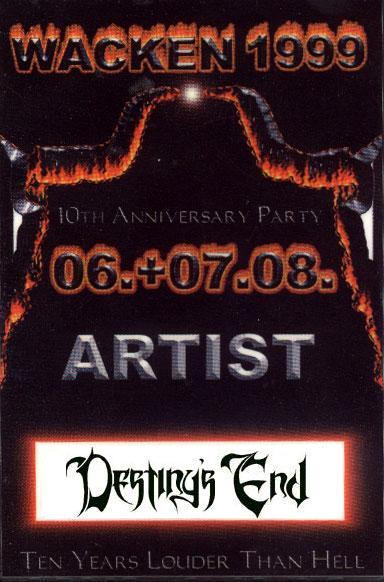
Destiny's End - Live at Wacken Open Air 1999

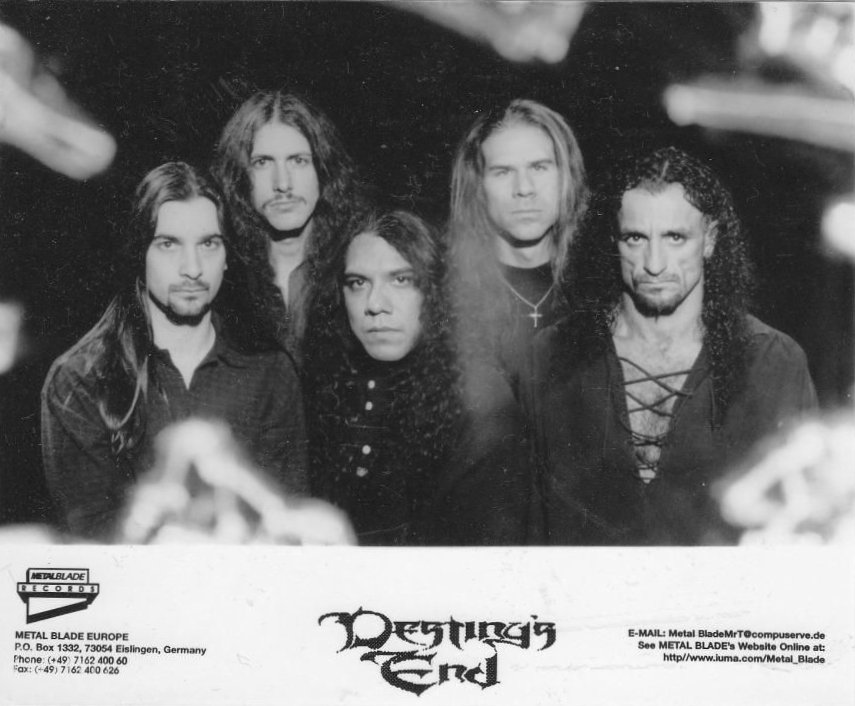
DE European promo glossy

[4 April 2017: This post is under heavy construction. -P]

I recently acquired the footage of Destiny's End at Wacken 1999 and uploaded it to YouTube for all to view. So, where do I start to blog the tale of the biggest gig of my career as a muso? From the beginning, I suppose...


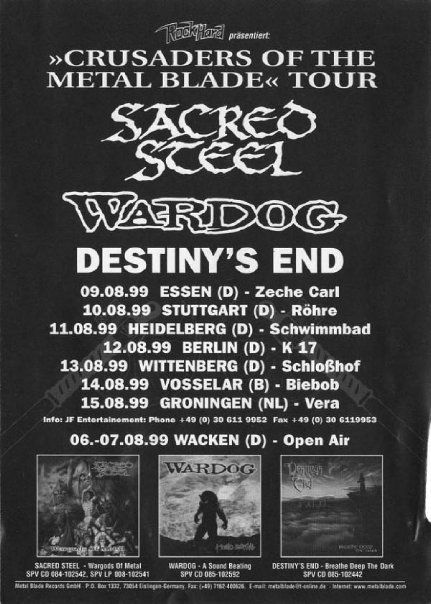
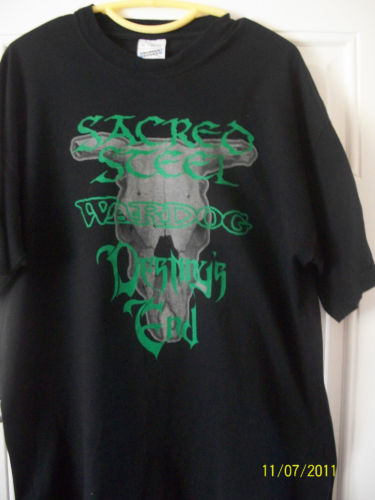
Metal Blade Germany got Destiny's End a slot on the prestigious Wacken Open Air Festival. The good news arrived shortly before we trekked out on a full-scale tour of the US with Iced Earth and Nevermore in May and early June 1999. A mini-European tour with labelmates Sacred Steel and Wardog was also arranged. We had no idea what to expect in terms of logistics. Would we be travelling in a van like in the US? Would we get shared motel rooms some nights? What about the back-line gear? What sort of guitar speaker cabs, bass rig and drums did Sacred Steel have to loan us?


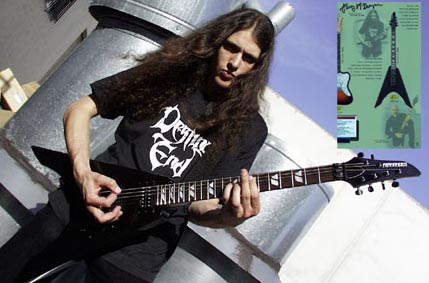
There were challenges to overcome in order to reach European shores. It was my first trip outside the US, and I was a bit stressed about the long flight. It started with some technical issues with one of my main guitars, a white early '80s B.C. Rich Warlock. I spent the night before our departure at Dan DeLucie's pad. We decided to do some last minute string changing. What should have been a routine job turned sour, and it was crystal clear that I wouldn't be able to bring the Warlock. I was kind of apprehensive about taking one of my more valuable axes, but resorted to my trusty 1976 B.C. Rich Eagle instead. As a backup I had a new Fernandes Vortex, a futuristic V-shape, which I wasn't worried much about. The Fernandes could be easily replaced.

Perry with Fernandes Vortex

As it was impossible for Dan DeLucie and I to bring our bulky amp/effects racks, we resorted to using our Mesa Boogie long-chassis heads. At least we knew we'd have adequate tone with our own amps. I borrowed Boss delay and chorus pedals from my pal Aric Villareal to complete the package. Our gear prayers were answered in an email exchange with the Sacred Steel lads. They had boutique German Engl speaker cabs to share with me and Dan, not to mention a full rig for bassist Nardo Andi and SS skinsman Mathias Straub loaned his Tama double-bass kit to DE's Brian Craig. All Brian brought were his cymbals, while Nardo simply needed one of his two Ibanez basses. Sorted! Well, almost...

We miraculously made it to LAX on time and ready for our long-ass flight. Metal Blade Germany arranged our tickets, and for some bizarre reason it was cheaper to fly to Amsterdam first and catch a connecting service to Hamburg. Budget-wise it was a good decision. On the other hand, it could - and did - cause major problems.

After deplaning and making our way through customs, we hightailed it to the baggage claim area to find our gear. Andreas Reissnauer, one of the Metal Blade Germany guys, was there to greet us. The baggage carousels spun around as the minutes ticked away, with no sign of our gear. The oversized luggage section similarly yielded nothing. Though most of our clothes were intact, it became clear that our gear was lost. Andreas spoke to the Lufthansa luggage people. Did he get the message across? Who could tell? What to do, what to do? Whose fault was it? Was Metal Blade the culprit for flying us out the same day as such a critical festival gig, a scant few hours before stage time, knowing fully well that our gear might not make the same flight as us? Did it really matter who was to blame? Hell no! We needed to devise a solution. And quick!

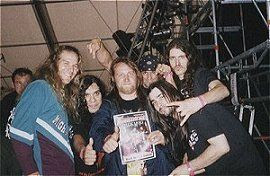
DE at Wacken with Jason from Friday the 13th 'zine


Awake for something like 24 hours, we weren't very prepared to hatch a desperate backup plan. I slipped in and out of a troubled sleep, sitting up in the van on the way out to the fest. Upon arrival at Wacken, we were greeted by Michael Trengert, the head honcho of Metal Blade Germany. He told us we'd better get cracking on finding some gear to use. Tell us something we didn't already know!? I was understandably pissed off at Michael for not flying us out a day before our scheduled appearance. I was pretty annoyed, but got past it swiftly. Michael walked us through the throngs of camping metalheads to meet our new partners in crime, Sacred Steel. We were totally blown away by the double-decker tour bus. But beyond that, would Sacred Steel be willing to help us out? Fortunately the answer was affirmative. Lucky for me, I scored rhythm guitarist Oli Grosshans' trans red B.C. Rich Mockingbird, while Dan ended up with Jorg Knittel's black Charvel bolt-on. Nardo got Jens Sonnenberg's Ibanez four-string, comparable to his own. Another hiccup was introduced, though. Oli and Juerg explained that Sacred Steel tuned their axes down a whole-step to D, while we tuned to standard (E), in Destiny's End. I broke the news to the DE guys. We couldn't tune up to E, as the axes weren't set up for that sort of string tension. We were forced to stay in D for the Wacken set. Another wrench in the works, eh? James would have to transpose his vocals down on the spot to match our whole-step detuning. I often wondered what DE would sound like tuned to D. My fave ultra-heavy band, Death, played in D, and I tuned to E flat in the short-lived Stormhaven in 1996.


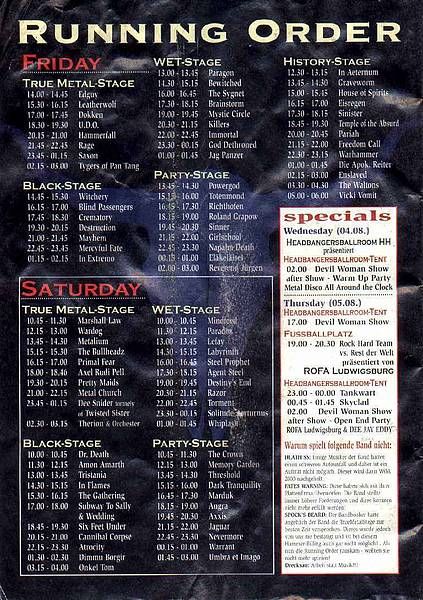
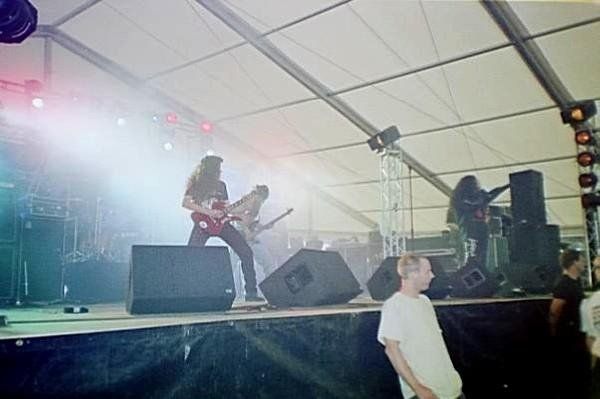
How about the amp situation? Well, it was explained to us that the festival itself had a backline on all of its stages. We made our way through the muddy festival ground, borrowed guitar cases in hand. There was so much metal happening simultaneously, on something like 6 stages. The sheer number of people who flocked to Germany's equivalent of a metal Woodstock was mind-boggling. Looking at the Wacken program, we discovered that we were to play on the Wet stage, one of two smaller stages. Smaller? This was Wacken, and our stage was still pretty massive, easily beating our biggest US gig at the Bluebird Theater in Denver, Colorado. Our adrenaline was beginning to surge. I noted that NWOBHM titans Jaguar, our old touring comrades Nevermore and Metallium (featuring Savatage guitarist Chris Caffrey) were heating up the Party Stage directly across from us.


Slated to play on the Wet Stage before us were our So Cal pals Steel Prophet, followed by Agent Steel. It was comforting to see familiar faces. We hung out backstage with Agent Steel and explained our gear situation. Immediately, a lifesaver was provided by AS axemen Juan Garcia and Bernie Versailles, in the form of a chromatic guitar tuner. Phew! We were very appreciative to Sacred Steel and Agent Steel for saving our asses at Wacken. We stared on as Steel Prophet's Steve Kachinsky jumped around the stage like a madman. Texas doomsters Solitude Aeturnus and Canadian thrashers Razor followed in DE's wake.


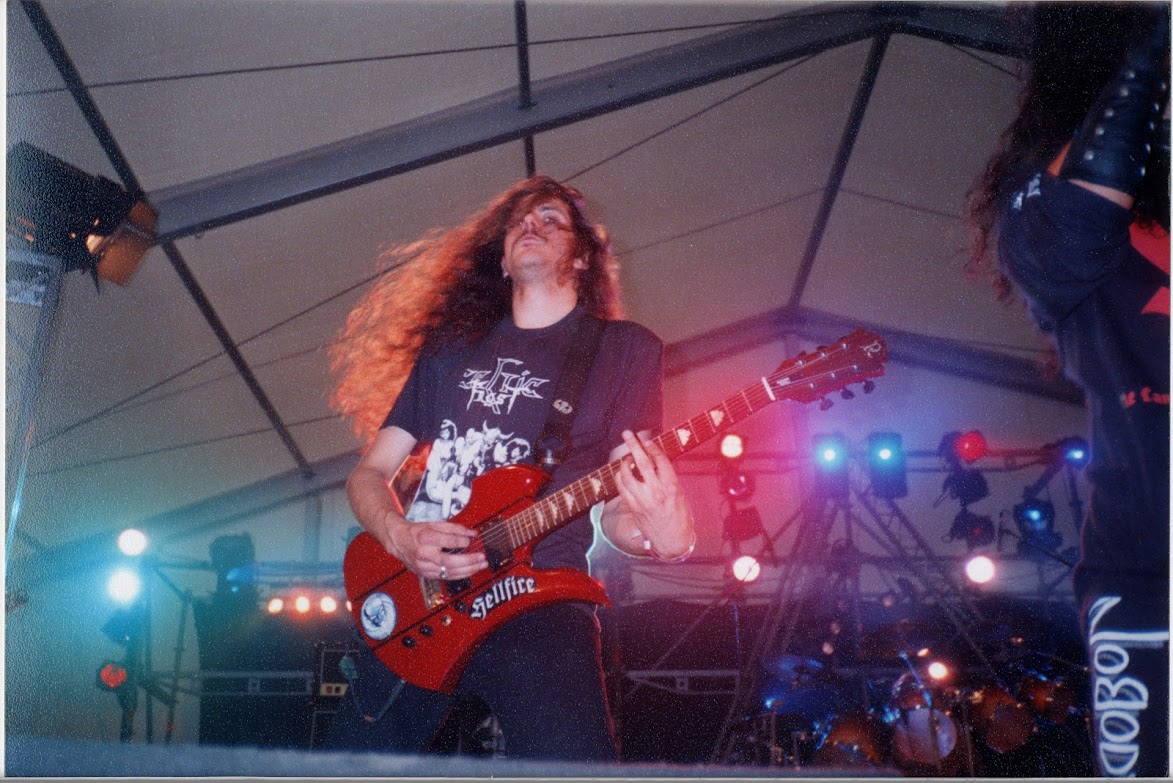
We were on metal overload, and I was a bit more nervous than usual, fearing I might forget how to play a riff or solo. My anxiety was quickly quelled, though. We exchanged pleasantries with Steel Prophet after they departed the Wet Stage and we climbed aboard to find out what our backline consisted of. A couple of Marshall Major JCM 900 200 watt heads and full stacks for me and Dan. An Ampeg SVT head and 8x10" refrigerator cab for Nardo. Brian got to use a Tama double-bass set much nicer than his own Pearl Export Series kit. James lucked out that he had his stage gloves in his carry-on baggage. But James' stage clothes, like our gear, didn't make the flight to Hamburg. As a result he was forced to hit the stage in a Warlord longsleeve and a pair of black sweat pants. The rest of the DE guys wore street clothes live, so it didn't really matter. I chose my Celtic Frost Emperor's Return bootleg t-shirt. Setup time was minimal thanks to the festival's backline.

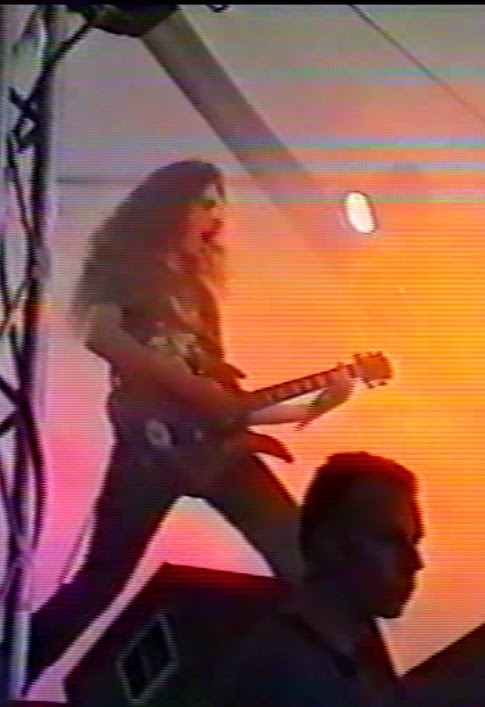
Perry at Wacken


Dan and I tweaked settings on the Marshalls to approximate our usual high-gain Mesa Boogie tone. We didn't have overdrive or distortion pedals, so it was a relief that the amps themselves pumped out plentiful gain. The sound engineer must've read my mind, as he threw on Death's Individual Thought Patterns on the enormous PA system. I further tested my hired amp by jamming along to "In Human Form". After all, I was tuned to D!

Crusaders of the Metal Blade Tour shirt

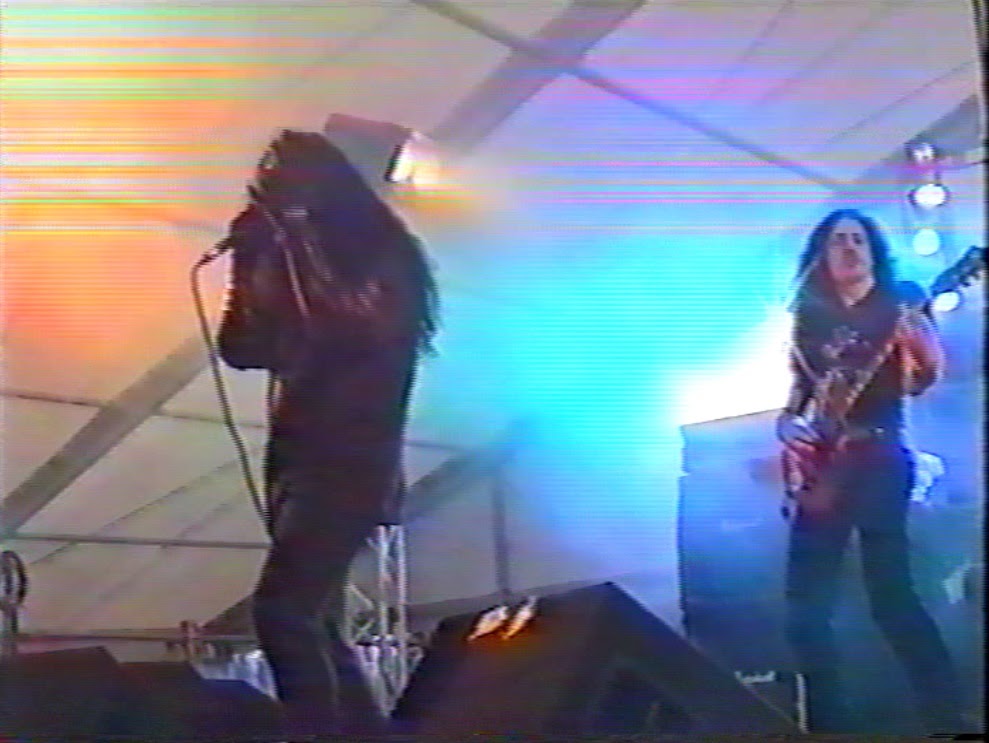
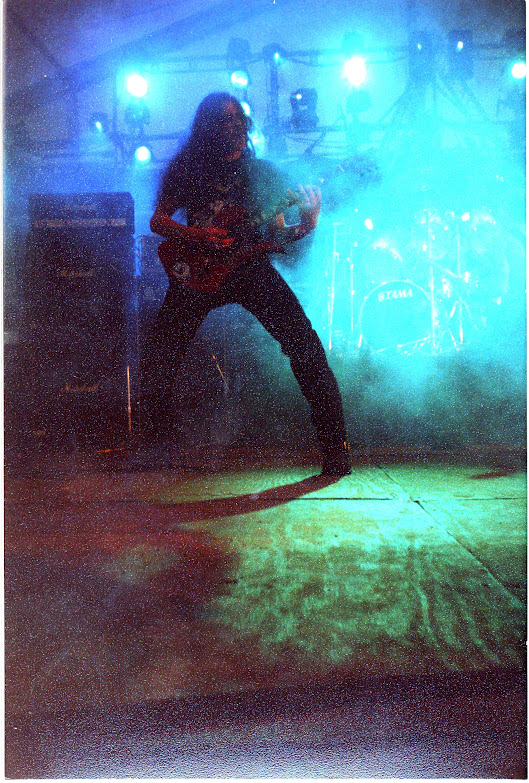
Before we knew it the set was off to a heavy start with mid-paced cruncher "Unsolved World" as the opener.I felt totally at home on Oli Grosshans' Mockingbird. The Wacken audience got a real treat in Dan's new song "Transition", which became the title track to DE's second album. A major difference between this early live version and the recording was Dan's clean-tone guitar intro accompanied by my lead melody. The intro was ditched by the time we demoed the tune months later. Other tunes in the Wacken set were "Breathe Deep the Dark", "Rebirth", "Under Destruction's Thumb", "To Be Immortal", "Idle City/The Fortress Unvanquishable", a cover of Judas Priest's "Beyond the Realms of Death" and Helstar's "The King Is Dead". The feeling of playing in front of a sea of thousands of metal maniacs was unbelievable. A genuine natural high! The crowd went nuts in between songs, chanting at the top of their lungs, "Hey, hey, hey!"


Following DE's set I spotted Solitude Aeturnus bassist Lyle Steadham and caught up with him. We'd last met at DE's March '99 gig in Dallas/Fort Worth at Dimebag Darrell and Vinnie Paul's Tattoo Bar. My old friend Rob Preston also made the pilgrimage to Wacken, and we watched several bands together, including the German thrash band Warrant. No relation to the glam act of the same name!? An interesting aside: Swedish black metallers Marduk were meant to play the Wet Stage several bands after DE, but they failed to appear. In their place was an S&M striptease act, followed by our cohorts Sacred Steel.


Waking up in the bus the morning after Wacken, we discovered our gear had arrived from the airport. What a relief! My UK pen-pal, Solstice's Rich Walker and his wife Lucy were along for the ride with DE and Sacred Steel. The seeds sown at Wacken and the subsequent mini-Euro tour would eventually lead to me playing with Rich on the Isen Torr EP, Mighty and Superior

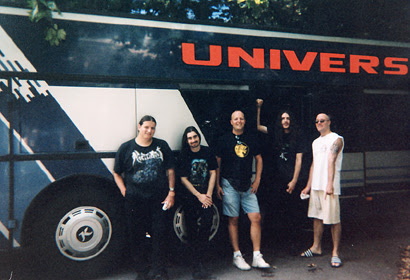
Jens Sonnenberg, Dan DeLucie, Jim Powell, Perry and Gerrit Mutz


What about the tour? Suffice it to say that it was a well organized and professional affair. We shared a massive bus with Sacred Steel and got enough sleep in our bunks to be at the top of our game every gig. That's not all we shared with Sacred Steel. We had a tour manager, a merch girl, three roadies, including guitar and drum techs. Dan, Nardo and I didn't even have to change our own strings, which was a breath of fresh air. There was even a wee bit of pyrotechnics in the form of small flash-pots. Although part of the package tour, Wardog travelled on their own in a van with their wives and got motel rooms. Slough Feg was the opener on a couple of dates.


Monday, November 7, 2016

Falcon - Self-Titled Album (2004)

[22 November 2016: This post is under heavy construction. I'll be adding more text, links, photos and correcting errors as time moves along. -P]

For a limited time I'm offering the eponymous first Falcon disc for free download. I'm down to my last few remaining copies of the second small pressing. Rather than letting it languish out of print and fade into obscurity, I'm making it available to fans old and new.  


Here's a link to the compressed .zip file - http://www.falconband.net/sounds/falcon.zip

Simply right-click on the link and "save link as". Then decompress once you've downloaded the .zip file.

Perry Grayson - Guitar/Vocals
Greg Lindstrom - Bass/Keyboard/Additional Lead Guitar on *
Darin McCloskey - Drums

Basic tracks recorded live in November 2003. A few overdubs and mixing conducted in February 2004. Engineered, mixed and mastered by Chris Kozlowski at the Polar Bear Lair in Middletown, Maryland. Produced by Falcon and Chris Kozlowski. Released May 24, 2004 on Liquid Flames Records, piece code LF002.

1. Downer (Grayson)
2. Castle Peak (Grayson)
3. On the Slab [guest lead vocals by Bobby Liebling from Pentagram] (Grayson)
4. The Crying of Lot 246 (Grayson)
5. Throwback (Grayson)
6. Redman [Bang cover] (D'Iorio, Ferrara & Gilcken)
7. High Speed Love (Lindstrom) *
8. Route 666 (Lindstrom)
9. Shelob's Lair (Lindstrom) *
10. Half Past Human (Lindstrom) *

The Eponymous Epic!


The self-titled Falcon album has to be my fave recording experience of my career. Not only do I love it sonically, but I really dug/dig everything about the project from start to finish. I don't use the term "project" to describe Falcon, though. It's a serious band situation.

Me and Greg L. flew out to Pennsylvania on November 19, 2003, for two days of wall-to-wall jamming at Pale Divine's rehearsal space (the Glen Mills, PA community center basement). Then we drove down to Maryland and hit the Polar Bear Lair studio for 5 more days. We banged out the basic tracks within two full days, followed by 3 more days of overdubs and mixing - a couple of guitar solos, vocals, percussion, etc. The result was a spontaneous, raw sounding album. We truly bashed it out as quick as humanly possible! A breath of fresh air compared to the recording sessions of Destiny's End - Breathe Deep the Dark.

Chris Kozlowski did an incredible job engineering and  Darin did a killer job behind the kit, despite the fact that we haven't had more than like 6 rehearsals with him! An especially huge thanks goes out to Greg Diener (guitarist/vocalist of Pale Divine) for loaning me his old Sunn Sceptre head for rehearsals. We returned to the Polar Bear Lair from February 18th to 21st to do a couple of last overdubs and to mix.

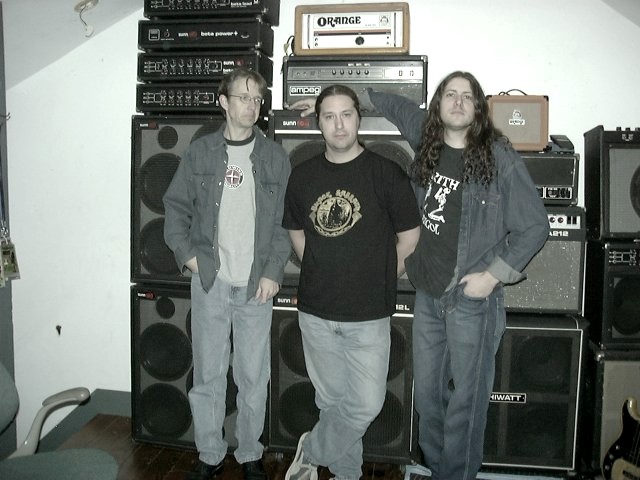
Greg, Darin & Perry inside Chris Kozlowski's Polar Bear Lair, Nov. 2003


Sunn Sceptre 60 watt head

For all you gear geeks (like me, Greg and Darin), I used my 1976 Les Paul Deluxe for all of the basic tracking and most of the solos. I brought my 1976 B.C. Rich Eagle Supreme on the February trip to lay down a couple of solos and to double-track some lead passages as well. Greg used his Fender USA Custom Shop Jazz Bass and his Les Paul Jr. (think vintage Leslie West) for his solos. Greg's keyboard parts on "Downer", "Lot 246" and "Half Past Human" was carried out on a Novation K-Station. Amp-wise I used Chris Kozlowski's original Sunn Model T for about 75% of the recording and an Orange Overdrive Series 2 (until it blew up) for overdubs.
Sunn Model T 120 watt head

Orange Overdrive Series 2 Head
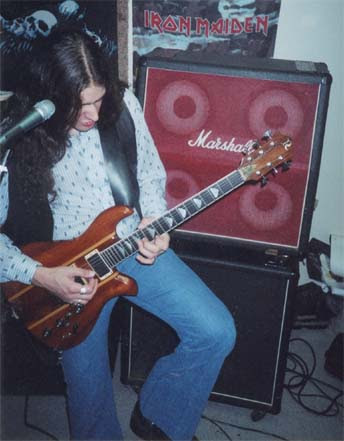
Perry with his B.C. Rich Eagle Supreme & Marshall stack at the Artisan jam room, NoHo, CA - 2003 


The Story Behind the Cover

At first we wanted to keep with the Cirith Ungol tradition of using art depicting Michael Moorcock's albino elf anti-hero, Elric. We approached artist Robert Gould to see if we could license the cover of The Elric Saga Part I. It suited Falcon, as it depicted Elric with a bird of prey on his shoulder. At first Gould seemed interested, but eventually he just gave us the cold shoulder.

Full color scan of Michael Moorcock's Elric of Melnibone by Robert Gould

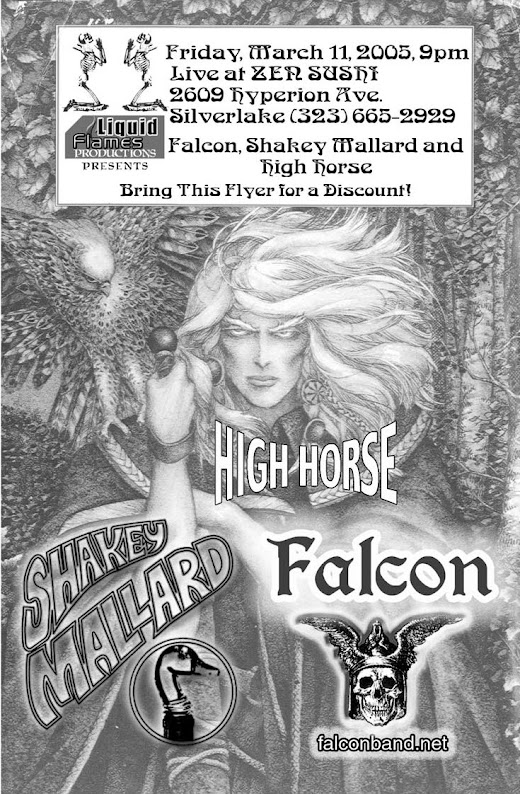
Perry's b-day gig in '05 with Shakey Mallard & High Horse. Get your sushi 'n' rawk on!!

The S/T Nitzinger LP cover
It wound up better that way, as I discovered the perfect cover in a pen and ink piece by renowned fantasy artist Virgil Finlay. Finlay's illustration is of a skeletal warrior on a beach surrounded by seagulls. Being that I worked in graphic design/advertising, I chopped the skull out of the larger artwork, leaving the winged helmet in as well. The result was not only an album cover, but the perfect colophon/logo for Falcon. I quickly got in touch with Finlay's daughter through an old weird fiction friend, editor Joe Wrzos, to secure rights. From that point on the helmeted skull graced nearly every Falcon gig flyer. The final cover is a combination of Finlay's finest and a backdrop of black leather amp leather or Tolex and the logo in silver embossed foil stamping as on the self-titled Nitzinger LP (1972).


The infamous first Falcon gig flyer!

Track by Track Notes

1. Downer
This one isn't about popping pills. Quite the contrary, it's a philosophy. Taking things raw, without a crutch, heeding "the worse case scene". There's also a politically charged bent to the lyrics. The "banished utopia laid to waste before its time" serves the purpose of having a bite at Uncle Sam. Riff-wise, there's a little tidbit about the intro/outro worth mentioning. Rob Garven, the Cirith Ungol skinsman, said, upon receiving his copy of the S/T Falcon album, "It reminds me of Heart's 'Barracuda'. It wasn't a conscious effort. Just something that occurred by chance. I've always felt it owes more to Pentagram (circa Day of Reckoning) and Quartz (think Stand Up and Fight) than anything else. Greg played the honky tonk piano synth in the solo section of this one.

2. Castle Peak
Castle Peak is a mountain wedged between my old suburb (West Hills) and the ritzy gated community Bell Canyon in sunny Southern California. I hiked it many a time during my early teen trials and tribulations. Climbing Castle Peak cheered me up when I was down, prior to obtaining my very own electric axe. On the lower slopes of Castle Peak there's a cave, fondly referred to as the Bat Cave by the teenage heshers who used to hang out there. Castle Peak was used as a ceremonial site by the Chumash during the solstices, The Cave of Munits – which lies in direct sight of the rocky peak, was said to be the home of a powerful Chumash shaman who was killed after murdering the son of a chief. There are stone alcoves at the summit of Castle Peak. In and near the alcoves were heaps of of heavy rock 'n' metal graffiti. Back in my high school days (daze) there was spray-painted the likes of Iron Maiden, AC/DC and Metallica. Before these sprawling trails were officially preserved as parkland there was an overzealous security guard patrolling this parcel of land, formerly called Ahmanson Ranch. The rent-a-cop brandished a gun loaded with rock salt. Fortunately I was never caught by the guard, although I know others who were shot at and detained. All that nonsense came to a halt in 2004 when the Victory Trailhead, El Escorpion Park and the rest of the former Ahmanson land opened for public use. For once the politics of land/property development sided with the nature loving common person. I was stoked to the max and celebrated the cool situation with a trip to ye old Bat Cave.

Philip Parris Lynott - the original Rawker (1949-1986)
3. On the Slab
"On the Slab" is my tribute to Phil Lynott and Thin Lizzy. I'm heavily influenced by both the Eric Bell-era power trio and the classic lineup with the duelling guitars of Brian Robertson and Scott Gorham. They're a special band for Greg Lindstrom too. He and Cirith Ungol drummer Rob Garven used to wear homemade Thin Lizzy t-shirts on their rounds of SoCal record shops like my old hangout, Moby Disc in Canoga Park. The title stems from the story of the same name by Harlan Ellison. "On the Slab" was Ellison's paean to H.P. Lovecraft. This one's rooted in reality rather than fantasy. It's painfully obvious that this tune is a tale of a smack addict going down the drain on drugs. It could just as easily encompass blow and meth as well. (As in "inhaling your death off a slab".)

Bobby Liebling, the voice of Pentagram!
Ironically, "On the Slab" has guest lead vocals by none other than Pentagram's Bobby Liebling, himself a storied smack and crack addict for the majority of his life.

I originally laid down vocals on both the demo and album versions of the tune, but I just wasn't happy with the results. As the vocal tracking came to a close it was evident that I'd either need to revisit it or... The possibility of Bobby coming in to lend a hand - or pipes. Bobby previously made a guest spot on Pale Divine's Thunder Perfect Mind, on the tracks "20 Buck Spin" (a Penta-cover) and "Dark Knight". So, it goes without saying that both drummer Darin McCloskey and engineer Chris Kozlowski were friends of Bobby's already. The latest version of Pentagram (with the 3 instrumentalists from Maryland doom kingpins Internal Void) was finishing up tracks for the Show 'Em How album, also with Chris Kozlowski at the helm. Kelly Carmichael (guitar) and J.D. Wiliams (vocals) from Internal Void paid a visit to us while we were recording overdubs. At Chris' recommendation I left my lyrics sheet and a note to Bobby with my cell phone number. I didn't expect he'd want to sing it due to the too close-to-home theme. On the contrary, Bobby rang me up and raved about how authentically Lizzy-like the tune was and that he'd be very happy to vocalize a tribute to our and his big hero, Philo. Bobby rang me several times, even during the wee hours of the morning. He left me messages to show me how he wanted to sing parts. We had some good phone chatter. In the end, we were thrilled with Bobby's rendering. Bobby went off the rails again around the time we released the S/T Falcon CD. I called him and he nodded off on the phone. A while later he screwed over the Internal Void guys by collapsing on stage at their first (and only) gig before a note was even played. Hopefully he's doing better now than he was back in '04. To this day I’ve never met Bobby, but we had some good long talks on the phone, and I hope to see him live with Pentagram someday.

4. The Crying of Lot 246


The title of this one is a play on Thomas Pynchon's 1965 novel The Crying of Lot 49. Thematically it's slightly similar to "Castle Peak". "Lot 246" also has something in common with Grand Funk Railroad's "Save the Land". It's about conserving land, lashing out against greedy commercial/corporate property developers. Getting back to nature. That sort of thing... Both Greg Lindstrom and I are big fans of Cream, and the chord progression in the chorus of "Lot 246" brings to mind "Tales of Brave Ulysses". Chronologically, this one was the second track I wrote for Falcon - also the second I demoed with a drum machine in autumn 2002.


5. Throwback
For the most part, "Throwback" is just a let loose and have fun type of song. I still managed to inject some seriousness into the fray. The lines "They watch my heroes die / Public eye don't cry" imply that the media doesn't care about the passing of talented musicians. Like say Chuck Schuldiner of Death and Control Denied fame. Randy Palmer (Bedemon, Pentagram) is another that comes to mind. The rest of the lyrics deal with the uninitiated not understanding the world of heavy rock and metal. Claiming it's too loud and "evil" sounding. Let's not forget all that demonic imagery. When I sang "I'm a throwback, baby / Born too late," I was quoting from the Wino-era Saint Vitus classic. I dig stuff that people call dinosaur rock (say Pentagram again!), I let my freak flag fly (the hair is flowin'!) and I love playing through a blaring full Marshall stack. Another Pentagram-related lyric is "livin' in a ram!" (as in "Living in a Ram's Head").

Leisure Suit Perry in front of the guitar cab shed at the Polar Bear Lair, Nov. 2003


6. Redman [Bang cover]
Bang is one of my all-time fave early heavy '70s bands. I'd call them proto-metal because of that outright heaviness.. They had three albums out on Capitol Records between 1972 and 1974. This one was on the self-titled Bang LP (1972). My old pal Rob Preston (Doomed Planet Records) hipped me to Bang. And they were the first band I wrote about in the pages of Metal Maniacs when I became a staffer in 1999-2000. Not only did I interview drummer Tony D'Iorio, but I became friends with Frank Ferrara (bass/vocals) and Frankie Gilcken (guitar) as well. We hung out one night in Hollyweird in 2000 and also in the studio in 2002 while they were demoing new songs. After the studio visit we adjourned to their friend's Calabasas home. I love the hippie-esque theme of "Redman" - again, a cautionary tale of not allowing the land to be raped by the Man and his penchant for war. Live, Falcon used to lengthen our version of "Redman" with an extended improv jam. Technically speaking, Bang tunes down a half-step (a semi-tone in the UK or Oz) to E-flat, while we tuned down a whole-step to D. This makes it easier on my voice and also adds a bit of heaviness to the whole affair.

7. High Speed Love
"High Speed Love" is an old Cirith Ungol tune from the late '70s. Greg wrote this fun little tune about fast cars. Both Greg and Rob Garven are big car racing fans. They love Ferraris and the like. I've never been much of a car geek, but I can understand their obsession with speedy automobiles. Tim Baker sang the original with backups by Rob and Greg.

8. Route 666
Another one of Greg's old Cirith Ungol songs which they demoed in the mid '70s. Greg wrote both the lyrics and music - and sang the original version himself. It's a horrific tale of a guy who comes face to face with a demon on a lonely desert highway. I had Greg's vocals to base my own delivery on thankfully.

9. Shelob's Lair
Fantasy geeks might realize right off the bat that this is Greg's take on J.R.R. Tolkien's Lord of the Rings. Like Zeppelin, Rush and Mountain before them, Cirith Ungol used the hippie's fave fantasy series for song fodder. Shelob was the giant spider who tangled with the heroes of the story in Cirith Ungol. Cirith Ungol was the high mountain 'pass of the spider'. Other Tolkien bits Greg inserted into the lyrics were the Ringbearer (Frodo the Hobbit), Samwise (Frodo's Hobbit friend), the Nazgul (Ring wraiths) and the magic sword called Sting. A rehearsal recording sans vocals was my only guide in how to sing/play "Shelob's Lair". I tried to deliver the lines as Tim Baker (the CU vocalist) might have.

10. Half Past Human 

The subtitle of this one was "A Quarter to Ape". The final S/T Falcon track is Greg's tale of the demise of man on Earth. Cirith Ungol demoed it in the mid '70s. He was heavily influenced by the fantasies of Jack Vance (The Dying Earth) and perhaps a hint of Clark Ashton Smith's tales of Zothique as well. Again, I had no vocal guide to follow beyond Greg's coaching. I tried to instill a bit of Iggy Pop into the line "Thirteen screaming souls / to feed the one within".